


Over 101,000 Bitcoin associated with initial addresses created between 2009 and 2017 was shifted in the first seven months of 2025, with July breakouts accounting for more than 80% of that total.
Old wallet, big movement
So-called “sleeping bitcoin” refers to coins held in a wallet that has not seen spending activity for many years. Often these types of wallets created in Bitcoin’s earliest years are closely monitored for signs of movement, and can show anything from owners’ access recovery to institutional positions.
According to tracking data from btcparser.com, the sleep bitcoin wallet tied to the early stages of the protocol moved a total of 101,003 BTC from January 2025 to July 25th. The parser essentially monitors blockchain transactions, including long wallets created between 2009 and 2017, providing rare insights into early holder behavior.
The most dramatic activity took place in July 2025, with an astounding 81,675 BTC transferred from 63 wallets. That month alone accounted for 80.8% of total Bitcoin spending annually. Of particular note is the enormous transactions of around 10,000 BTC each, everything from a wallet created in 2011.
The July figures were different from those observed in the past few months. In contrast, in June 2025, 1,671 BTCs moved to 43 transfers. The number of transactions remained relatively consistent, but the average size of each transfer in July driven by the 2011 origin wallet has swelled. In that month alone, 12 transfers from 2011 featured addresses totaling 80,026 BTC. This is an unprecedented awakening.
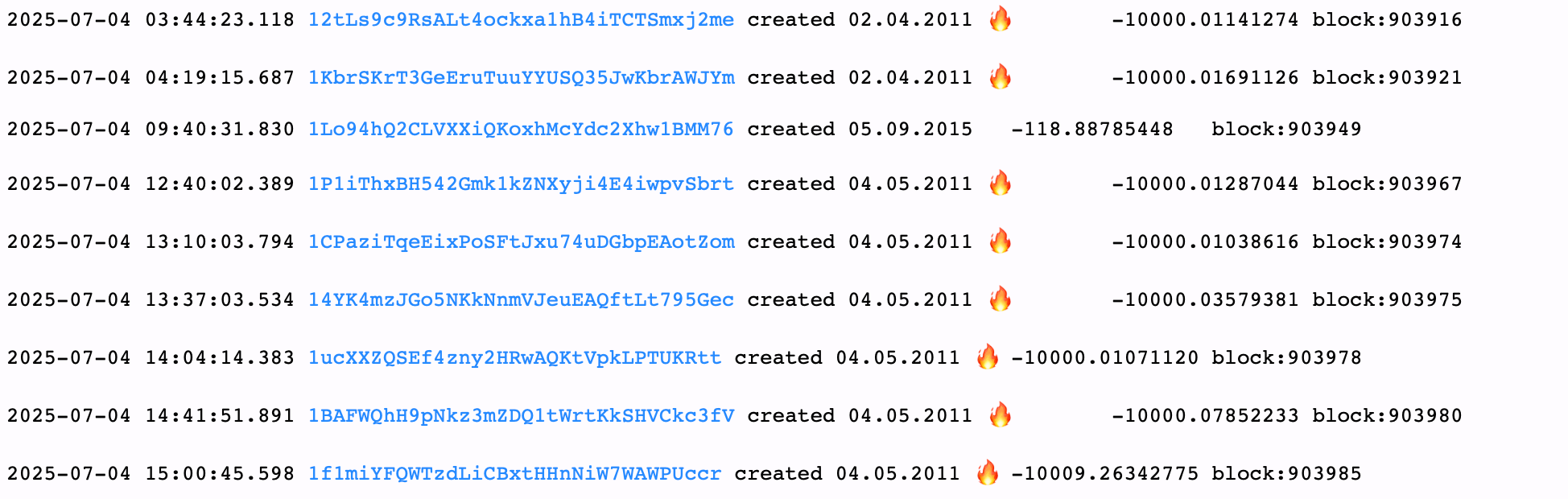
On July 4th, eight 10,000 BTCs will move, moving in addition to the 118.88 BTC movement from the dormant address in 2015.
May 2025 spent 5,798 sleep bitcoins over 93 transfers, marking the second highest monthly total. Most came from 2013 wallets (4,147 BTC). It was followed by activities from addresses in 2014 and 2017. April recorded 4,681 BTC in 100 transfers led by Wallet in 2015.
In March, 2,205 btc was spent on 69 relocations, with minor activities from the 2010 wallet (microscope 0.00014 BTC transactions) and a lonely 1 BTC move from 2012.
The February total hit 1,549 BTC in one movement of 50 BTC from the 2010 wallet. This is the only notable initial vintage spending of the month. Otherwise, transfers were distributed between 2011 and 2017, and the 2017 wallet contributed nearly 500 BTC.
January opened the year with 3,422 BTC moving with 89 Bitcoin transfers. The most active was the 2017 wallet (1,224 BTC), with spending continued from 2014, 2013 and 2016. The January activity variance is reflected in other non-July months, with transaction sizes ranging from 10 to 300 BTC.
Over all the months, old wallets from 2009 and 2010 rarely appeared. While the 2009 wallet remained dormant throughout the year, there were only two transactions in 2010.
The data show clear patterns of behavior. The modest and consistent movement from the wallets from 2013 to 2017 was interrupted by a sudden, overwhelming wave of activity in July 2011. The July phenomenon suggests a coordinated decision by early holders along with institutional stewards to ultimately move long-term historic funds for liquidation, security transitions, or internal restructuring.
It remains to be seen whether these events exhibit broader trends or isolated actions. However, blockchain tracing offers a rare glimpse into the early Bitcoin movement. 2025 is becoming one of the most active years of dormant wallet awakening in recent history.