
- Amidst geopolitical tensions, Bitcoin (BTC) fell 3.8% to $99,636.
- US airstrikes and Iran’s retaliation have sparked a global risk-off move.
Bitcoin (BTC) fell 3.8% in 24 hours at $99,636.89 on June 22nd. The global crypto market responded quickly to increased geopolitical risks and weakened technical conditions. Amidst the decline, Bitcoin’s market capitalization was $1.98 trillion, a 3.45% decline every day.
Meanwhile, 24-hour trading volume rose 17.56% to $522.4 billion, indicating an increase in panic activity. The market capitalization ratio rose to 2.52%, indicating heavy sales pressure.
The sudden drop is due to multiple interconnected drivers. Air strikes at Iran’s Fordow nuclear site have caused massive liquidation, wiping out long, leveraged positions of over $1 billion.
In retaliation, Iran closed the Strait of Hormuz, leading to a dramatic surge in global oil prices. As a result, feelings of risk have worsened across the market, with Bitcoin drugging low. The ETF influx also weakened, slowing from its peak of 9,700 to just 3,300 BTC per day, further weakening institutional enthusiasm.
Does BTC bounce back?
From a technical standpoint, Bitcoin was unable to hold a critical psychological level at $100,000. Current support appears near $97,000, with visible order book liquidity concentrated there. If Bears violates this floor, the next drawback is in the $93,000-94,000 zone, but the probability remains capped at 25%.
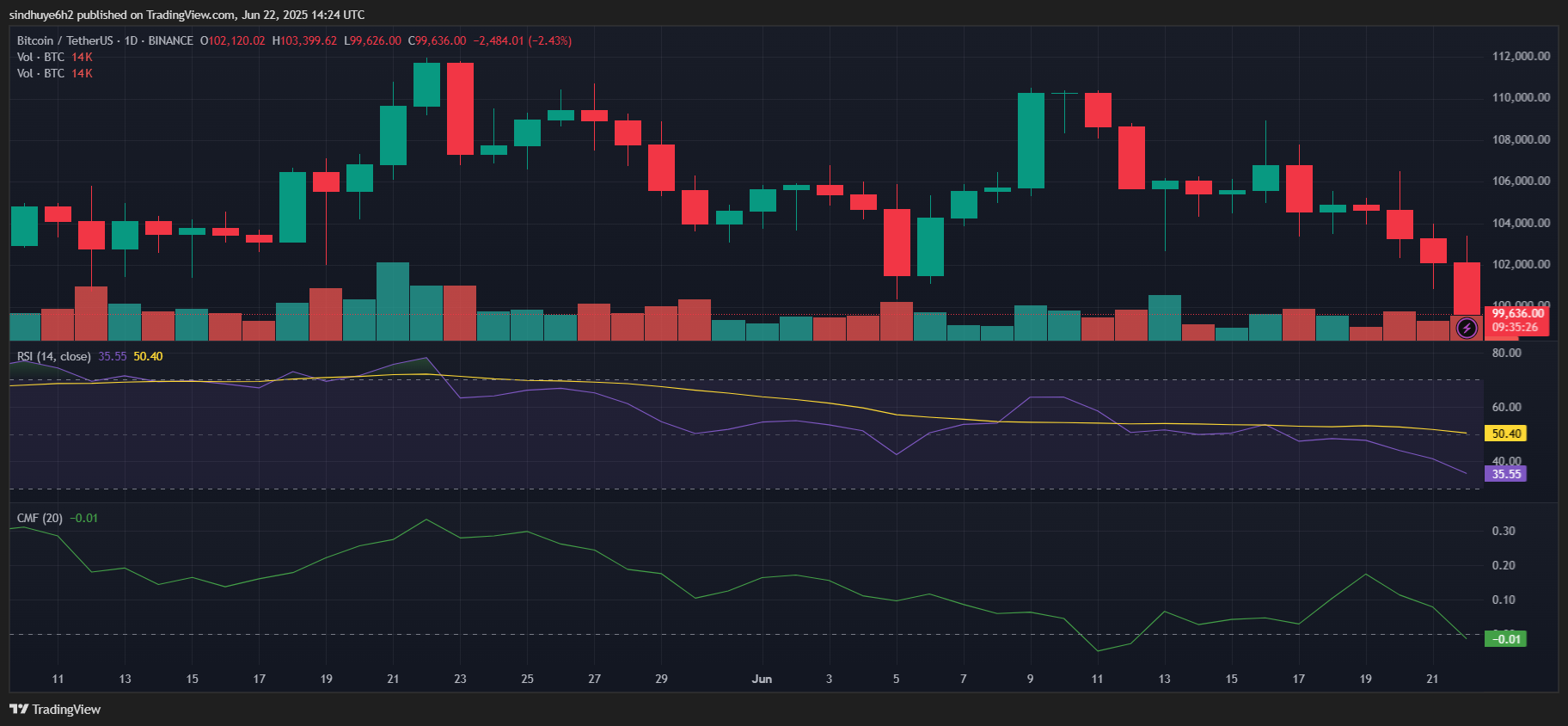
Meanwhile, resistance is approaching $102,000 and $106,000. A recovery of over $106,000 could change short-term momentum in favor of bulls. The indicators suggest a more downward pressure. The RSI stands at 35.55, below the neutral threshold and shows bearish momentum.
The RSI moving average currently at 50.40 expands divergence and confirms loss of purchase strength. Continuous drops below 30 are not yet present, but can indicate a very oversold condition.
At the same time, Chaikin Money Flow (CMF) is slightly below zero at -0.01, reflecting weak capital inflows. This reading often involves price instability and reduces investor convictions. Furthermore, moving averages were not able to actively cross.
Macro uncertainty dominates, but some traders hope that Bitcoin will rebound, as it has been gained from geopolitical turmoil from time to time. However, there are downside risks until stability returns or volume changes forcefully. Analysts are watching $97,000 carefully as a potential inversion zone, but the eyes also remain in the wider US and Iran escalation that could redraw Crypto’s short-term path.