


The US labor market clearly shows signs of tension. The Federal Reserve is under pressure to act as employment growth weakens and consumer sentiments point to an increase in unemployment. Economists hope that at least one rate will be cut in September and more will be tracked by the end of the year.
However, the market is already priced with a deeper easing cycle, and we hope that the Fed will lower the rate to the 3.5-3.75% range by December. This could reduce borrowing, pump liquidity into risky assets, and increase cryptocurrency. But there’s a catch. Inflation is sticky at around 2.9%, and tariffs are quietly creeping up to consumer prices. When inflation burns, the Fed can slow down its easing pathway and fall into market enthusiasm.
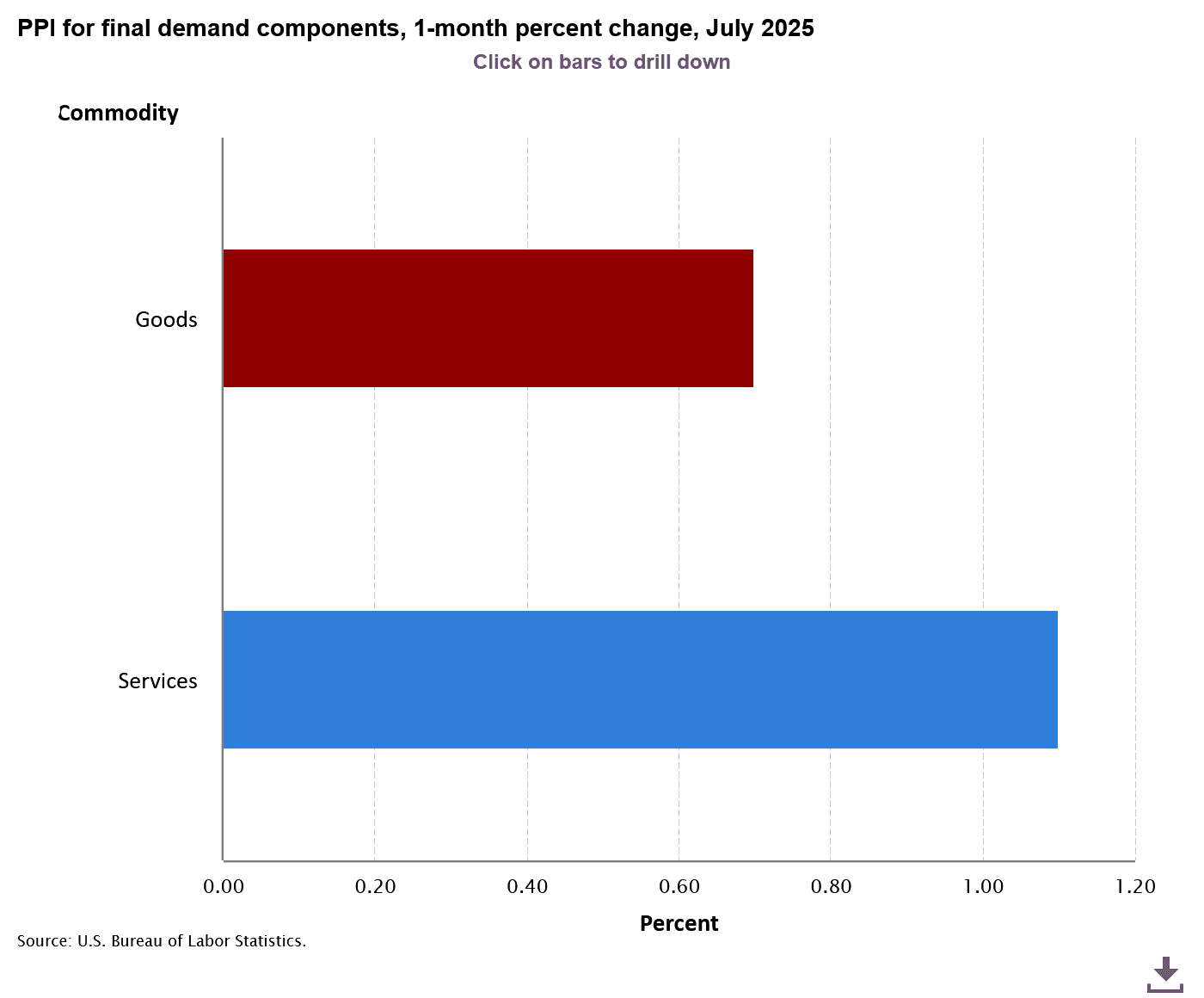
The background of this macro is important when it comes to Ethereum prices. Normally, lower rates increase growth demand and risk assets like ETH, while inflation risk results in volatility. Investors need to watch CPI prints as closely as they would look at the ETH chart.
Current Price Actions for Ethereum: Pre-Break Compression
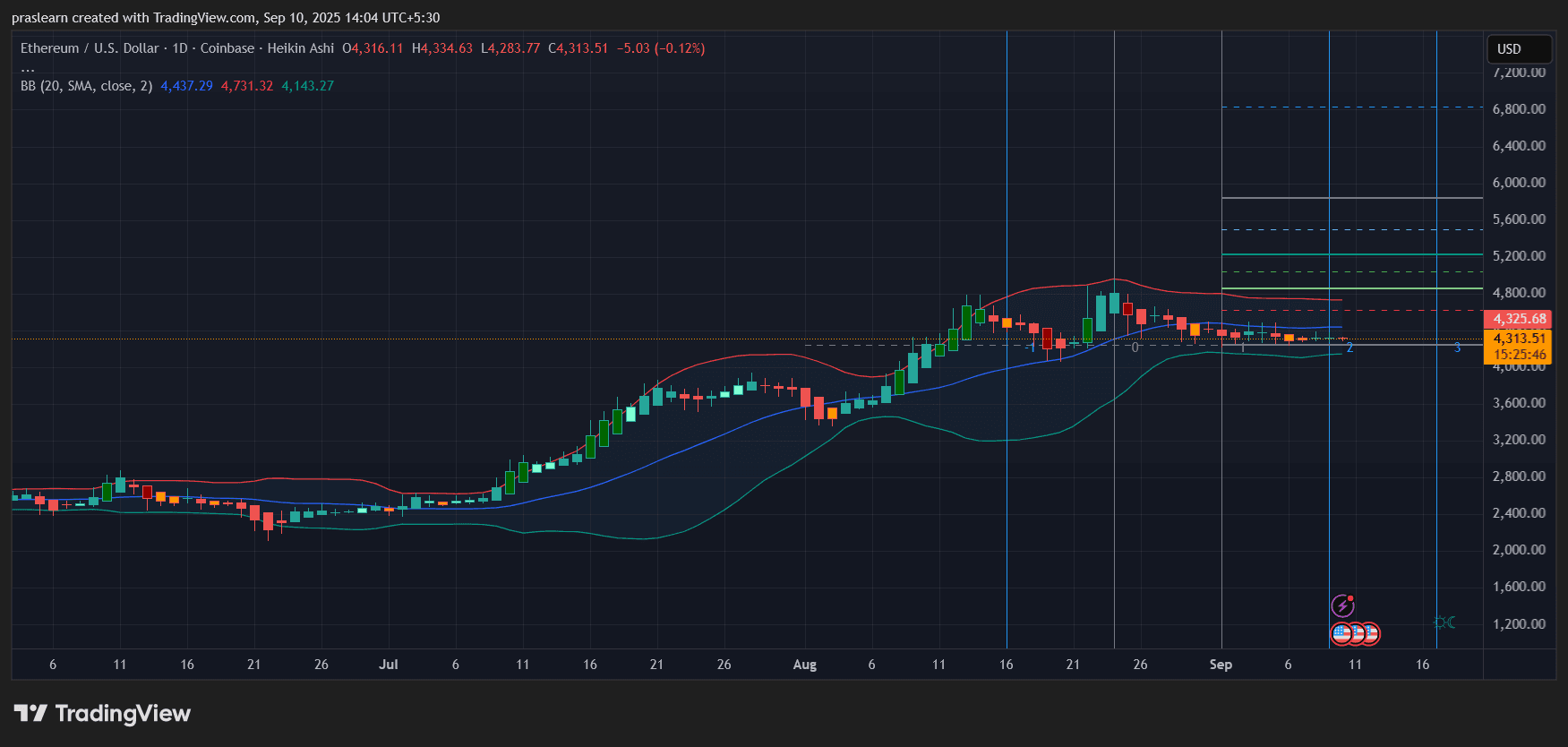
The Ethereum Price trades for around $4,313 and sits in the middle of the choking of a bollinger band. Volatility has been compressed sharply since late August, and textbooks show that there is a big breakout. The upper bollinger band is close to $4,731 and the lower limit is around $4,143, so you need to mark an immediate range ETH.
Recent price action shows that ETH prices have been consolidated after the July-August rally, with buyers defending the $4,100 zone. This integration has created a base that is slightly above the 20-day moving average. This suggests accumulation rather than distribution. However, if you can’t hold $4,100, you’ll open up a negative side risk to $3,800.
On top, breakouts above $4,750 could trigger a $5,200 rally towards the Fibonacci expansion level and $5,600 if Momentum matches Fed-driven liquidity.
Ethereum price forecast: What should investors expect?
The next few weeks will be important for ETH due to the alignment of macroeconomics and technology.
- If the Fed cuts by 0.25% in September And more mitigating signals could potentially allow ETH to break out of the integrated zone, covering the $5,200-$5,600 range.
- Limit the Fed’s behavior if inflation data is surprising higherETH stalls below $4,750 and risks revisiting support of $4,000-$3,800.
- More aggressive 0.50% Fed Cut Turbocharges can pose risks and ignite a breakout rally of $6,000 by the fourth quarter.
The real driver is how markets interpret the Fed’s balance between inflationary attention and labor weakness. ETH prices can earn money if investors believe that the Fed will make a mistake on the growth side.
Investment Outlook: Patience before positioning
Ethereum price is a game currently on standby. With the Bollinger Band compressed and the Fed’s decision looms, traders need to be prepared for high volatility. A disciplined approach is to monitor breakout confirmations that exceed $4,750 long before, with the outage level set at nearly $4,100. However, long-term investors may consider themselves immersed in $4,000 as an opportunity to accumulate before the next liquidity-driven gathering.
What this really means is that $eth is sitting at a macrotechnical inflection point. The Fed’s next move could unlock the next leg from $5,600 to $6,000 or force $Ethereum to a deeper retest of $3,800. In any case, the current integration will not last very long.