


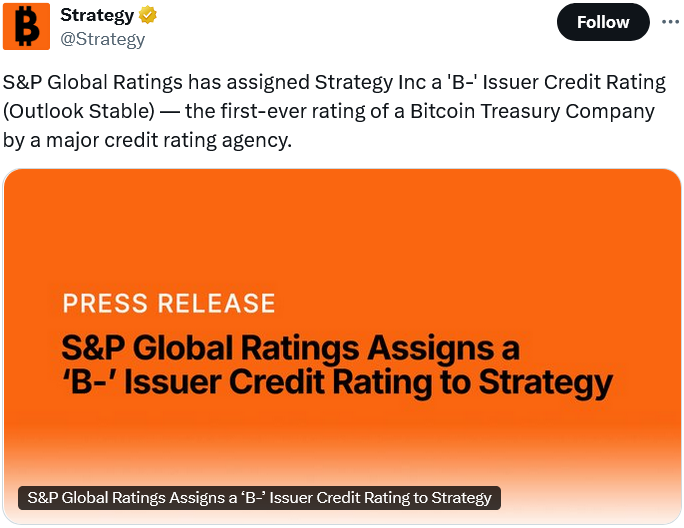
S&P Global Ratings gave Michael Saylor Strategy a “B-” credit rating, placing it in speculative, non-investment grade territory (often referred to as “junk bonds”), but said the outlook for the Bitcoin treasury company remains stable.
“We view the strategy’s high Bitcoin concentration, narrow operational focus, weak risk-adjusted capitalization, and weak US dollar liquidity as weaknesses,” the credit rating platform said in a review of the strategy on Monday.
Strategy has accumulated 640,808 BTC primarily through equity and debt financing. The stable outlook assumes the company carefully manages convertible debt maturities and, in some cases, maintains preferred stock dividends through additional debt issuance.
S&P Global highlighted that Strategy faces an “inherent currency mismatch,” noting that while all of its debt is paid in U.S. dollars, much of its dollar reserves are used to fund its software business, which operates at near break-even profits and cash flow.
sauce: strategy
This credit rating marks the first time that a company focused on Bitcoin finance has received an S&P Global Rating, and is important as it establishes TradFi’s benchmark for assessing the credit risk of companies that develop business models centered on Bitcoin and virtual currencies.
Strategy is similar to Sky Protocol
In August, Strategy received the same score as decentralized stablecoin issuer Sky Protocol (formerly MakerDAO).
S&P Global cited Sky Protocol’s high concentration of depositors, centralized governance, and weak capitalization to justify its B-minus rating.
To get out of the “junk bond” zone, the strategy would need to raise its B-minus rating six notches to BBB-minus.
The latest rating comes after Strategy was one of the best-performing stocks on Nasdaq in 2024, rising 430%. However, MSTR is down 13% year to date in 2025, according to Google Finance data.
This included Monday’s 2.27% gain, indicating that S&P Global’s rating did not have a negative impact on the company’s stock price.
Strategy must increase US liquidity and reduce reliance on debt
S&P Global said an upgrade in the next 12 months is unlikely, but could lead to a rating upgrade if Strategies continues to improve USD liquidity, ease convertible debt, and demonstrate strong access to capital markets, such as during the Bitcoin retrace.
However, S&P Global said there was a risk that Strategy’s convertible debt would come due at a time of “severe Bitcoin stress” and that the company would be forced to liquidate some of its Bitcoin at “depreciated prices.”
Additionally, a strategy’s score could decline if its access to capital markets weakens, straining its ability to raise capital or continue its Bitcoin strategy.