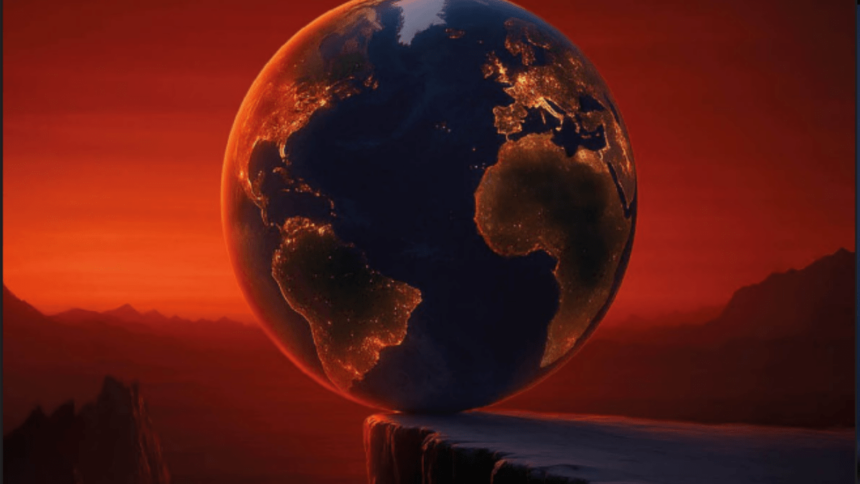
The world faces a panorama of uncertainty and increasing competition. This is what the World Economic Forum’s (WEF) Global Risks Report 2026 reveals, which describes an “economic calculation” in the context of confronting interrelated risks that could destabilize societies and economies over the next two years.
This paper analyzes global risks over three time periods (2026, through 2028, and through 2036), based on the Global Risk Perception Survey (GRPS), which involved more than 1,300 analysts.
Instead of a rigid structure of specific powers, the report emphasizes that: Dominant risks such as geoeconomic conflicts (No. 1 risk most likely to cause a major crisis in 2026, chosen by 18% of respondents). Misinformation and social polarization are also emerging, along with growing economic concerns such as recession, inflation, and the possibility of bursting asset bubbles.
The key factors identified include:
1.-Concerns about debt sustainability
The first area of concern highlighted by the WEF is the economy. Global debt has reached a dizzying $251 trillion, equivalent to 235% of global GDP. However, the problem is not just the scale, but also the “critical moment” that will approach between 2025 and 2027.
During this period, nearly 45% of the national debt of Organization for Economic Co-operation and Development (OECD) member countries A third of the world’s corporate debt will need to be refinanced. This scenario is hostile, as interest rates are at levels not seen in decades and public spending pressures are inevitable.
For many analysts consulted by the WEF, this financial bottleneck could lead to broader adjustments that increase economic volatility and destabilize markets and societies in the context of geoeconomic conflicts.
2.- Erosion of central banks
Financial authority control is evaporating as traditional institutions creaky under the weight of debt. The report warns of a growing trend of outflows to stablecoins in emerging economies, something CriptoNoticias has also observed.
The report indicates that these cumulative purchases could reach $1.22 trillion by the end of 2028, compared to about $173 billion recorded in October 2025. This forecast indicates that with the high adoption of these stablecoins and reduced central bank mobility, this flow of funds could weaken national financial systems and jeopardize the monetary sovereignty of affected countries.
3.-The mirage of geopolitics and AI
The third factor is the rift in the global dialogue. As documented, geoeconomic conflicts are escalating and represent the most serious looming risk in 2026. It added that the use of sanctions, investment controls and capital restrictions as strategic weapons hinders the possibility of a collective solution.
In this climate of distrust, massive investments in artificial intelligence, predicted to reach $2 trillion by 2026, are viewed with a mix of hope and skepticism. WEF analysts warn that if the profitability of these projects does not meet expectations, we could see: Bursting asset bubbles prompting investors to take refuge in digital assetsperceived as more resistant to state intervention and sustained inflation.
“Arashi” panorama
The consensus among the more than 1,300 analysts who participated in the forum’s survey is bleak. 50% expect the outlook for the next two years to be “chaotic or stormy.” In the long run, this number increases to 57%.
The report concludes that 2026 will mark the beginning of an “era of competition” in which protectionism will replace multilateralism.
Although the World Economic Forum avoids giving the exact date of the system’s collapse, the diagnosis is: The conditions are already in place for even greater economic and social changedriven by interrelated risks such as geo-economic conflicts, debt and bubble concerns, and the negative impact of AI.
The world is not only facing technological change. Navigating this uncertainty requires greater cooperation, rather than fundamental changes in money or state power, analysts conclude.