


During his recent visit to China, Canadian Prime Minister Mike Carney reached a series of agreements aimed at building a commercial alliance between the two countries. Canada now aims to increase exports to China by 50% as it prepares to face what Carney calls a new world order.
Canada signs economic deal with China in preparation for new world order
Canada and China are strengthening their relationship for the future.
The North American country has traditionally been considered an ally of the United States, but is now turning to China as a reliable trading partner after President Trump’s growing hostility and threats of tariffs soured relations with the United States.
Prime Minister Mike Carney said during his four-day visit to China that he was building a new strategic partnership with China for the “benefit of both peoples.” According to a press release, the new partnership will focus on cooperation in the areas of energy, clean technology and climate competitiveness.
The partnership includes lower tariffs on Chinese EVs, which will be reduced by 6.1% from 100%, and the Canadian government will allow up to 49,000 vehicles into the country. Canada hopes this will lead to an influx of investment into Chinese joint ventures, bringing their production into the country and favoring domestic workers.
In return, Canada would like to enjoy a 15% tariff on Canadian canola seed, down from 85%. This makes China a viable market for Canadian canola seeds, with the aim of capturing some of the $4 billion demand.
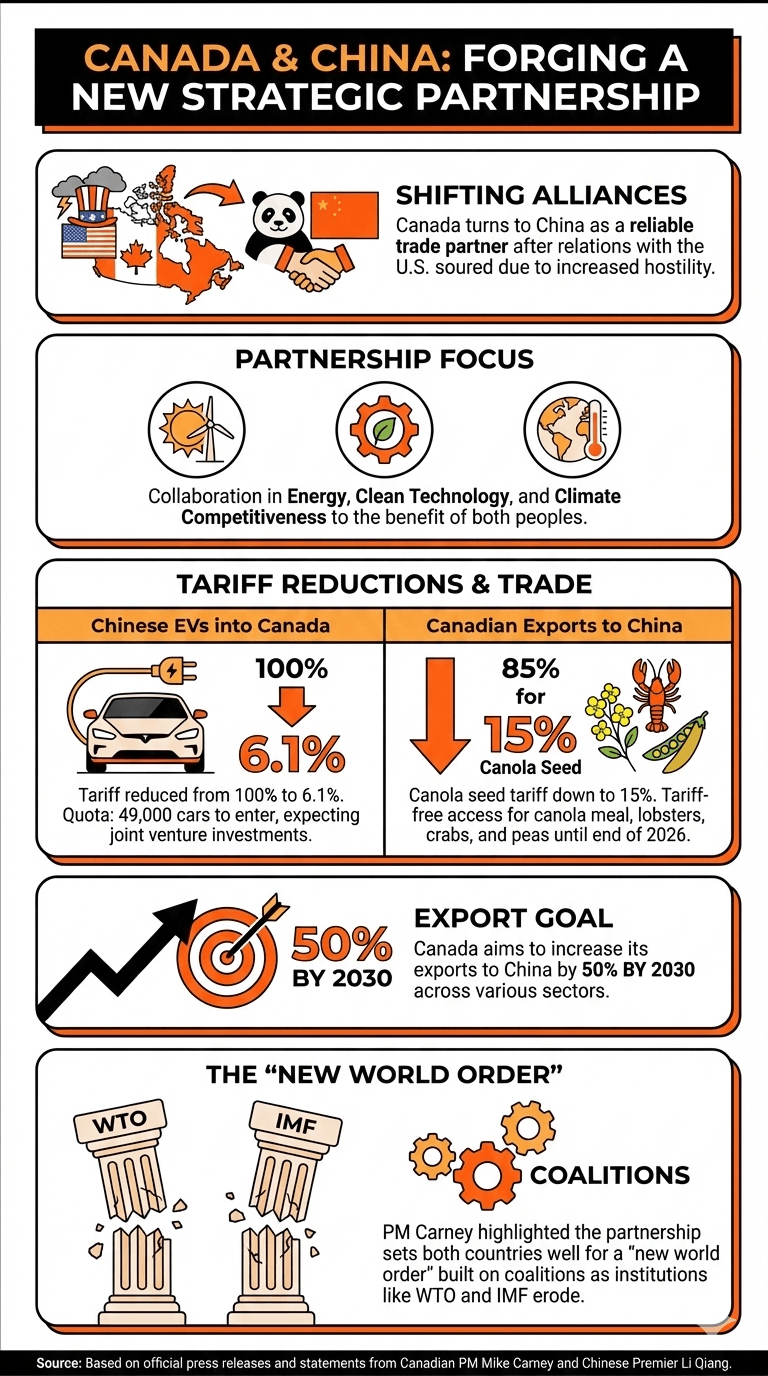
Canadian canola meal, lobster, crab and peas will also be exempt from tariffs from March 1 until the end of 2026. Canada’s goal is to increase exports to China by 50% by 2030, partnering in clean energy, technology, agri-food, timber and other sectors.
The partnership goes beyond economic and trade aspects, as Canada has pledged to support multilateralism and deepen cooperation to “improve global governance.”
In his meeting with Chinese Premier Li Qiang, Carney emphasized that the progress made in the partnership will move both countries toward what he called a “new world order.”
In a later interview, Mr. Carney said that this world order referred to the soon-to-be-established relationships among nations, organizations, and coalitions that would emerge as existing institutions such as the World Trade Organization (WTO) and the International Monetary Fund (IMF) declined.
Mr. Carney evaluated it as follows.
“Rather than these necessarily being developed through the IMF, the WTO, and other multilateral institutions, the expectation is that they will be federations that develop them for subsectors of the world rather than for the world.”
read more: President Trump offers free trade to Canada in exchange for citizenship, BTC dips below $80,000
FAQ
Why is Canada shifting its focus to China? Canada has strengthened its relationship with China as a reliable trading partner in response to rising tensions with the United States under the Trump administration.
What key areas will the Canada-China partnership focus on? The new partnership will emphasize cooperation in the following areas: Energy, clean technology and climate competitiveness.
What tariff reductions does the agreement include? China’s electric vehicle tariffs are 100%~6.1%Canada expects favorable tariffs on agricultural exports. 85% to 15% For canola seed.
How does Canada envision exports to China under this partnership? Canada aims to increase exports to China 50% by 2030expanding collaboration across a variety of sectors including clean energy, technology and agri-food.