


Bitcoin price fell below key short-term trend support as traders continued to deleverage across derivatives markets.
summary
- Bitcoin fell below short-term trend support as leverage eased.
- Derivatives data shows forced position resets rather than panic selling.
- The chart shows significant resistance on the upside and weak support on the downside.
Bitcoin fell to $88,218 at the time of writing, down 1.2% in the past 24 hours, as the price fell below key short-term trend support during continued unwinding of leverage.
Over the past seven days, the token has fluctuated between $86,319 and $90,475. The stock is currently down about 2% for the week and about 30% below its all-time high of $126,080 set in October 2025.
Spot trading increased during the downturn, with 24-hour trading volume increasing 12.3% to $49.1 billion. Derivatives positioning shows that the market is still shedding excess risk.
The reduction in open interest has been accompanied by recent fluctuations, a pattern consistent with forced deleveraging rather than stable physical selling.
This action fits into a reset phase where traders reduce exposure and wait for clearer direction.
CryptoQuant reports macro fatigue during leverage unwind
In an analysis on January 29, CryptoQuant contributor CryptoZeno said that Bitcoin ($BTC) Recent quarterly results indicate a shift from the strong expansion seen through mid-2025 to a phase of adjustment or consolidation.
Our analysis shows that the recent drawdown is not a full-fledged capitulation, but rather an entry into a deeper historical correction zone that is typically associated with a cyclical reset.
Prices trading below the one-year average drawdown indicate a slower, more cautious cooling phase where risk appetite decreases and capital deployment becomes more selective.
You may also like: Strive is among the top 10 latest Bitcoin holding companies $BTC buy and reduce debt
Derivatives data supports that view. Repeated sharp declines in futures open interest coincide with low local prices, indicating that leverage is being forced out of the system.
CryptoZeno added that the slope between the 90-day market price and realized price indicates a decline in macro momentum, a setup often seen late in the cycle where prices flatten while the market rebuilds a healthier cost base.
External pressure is increasing the sense of caution. In addition to the outflow of spot Bitcoin exchange-traded funds (ETFs) from late 2025 to early 2026, demand during the rebound will be limited due to the tight financial environment and growing risk-off attitudes.
Technical analysis of Bitcoin price
From a chart perspective, Bitcoin is holding in the $88,000 to $90,000 area, but well below its short-term trend structure. The decline in the 20-day moving average around $93,000-$94,000 signaled a clear change in near-term dominance as that level had served as support during previous economic expansions.
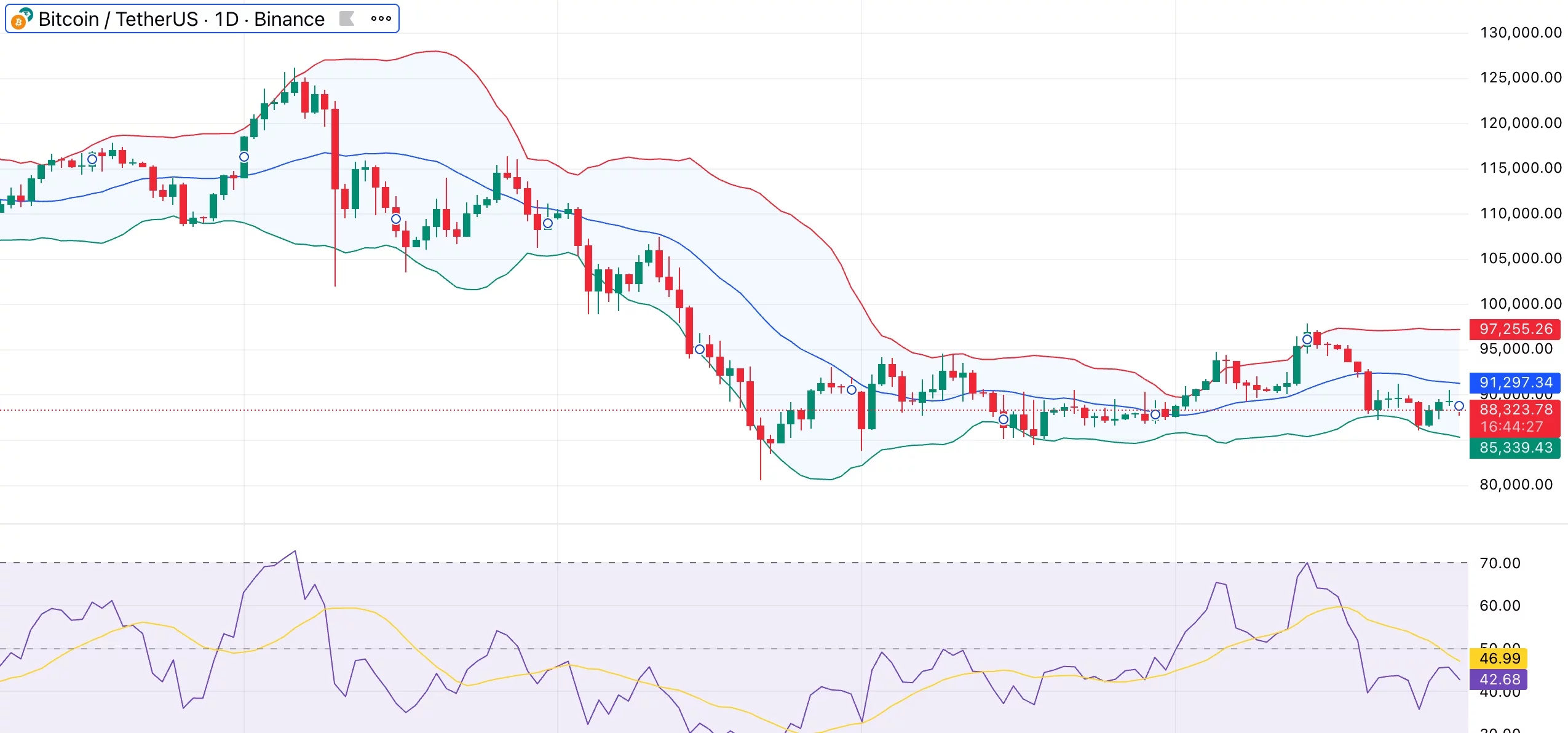
Bitcoin daily chart. Credit: crypto.news
Overhead resistors are now tiered. The 50-day average between $96,000 and $98,000 is the ceiling, and repeated failures below that zone continue to limit upside. Until price is able to regain that territory, the upside movement looks more corrective than directional.
On the downside, attention will be focused on the 100-day average of $84,000 to $86,000. Holding that zone will keep the pullback framed as a mid-cycle reset.
A break below this would expose a more serious downside towards the low $80,000 range, but the 200-day average is still well below that, around $74,000-76,000, anchoring the long-term structure.
The oscillator is clustered near neutral, but the relative strength index is in the low 40s, indicating a weak but unstretched condition. Selling pressure has eased compared to the beginning of the month, but buyers have not yet stepped in with confidence.
For now, Bitcoin is caught between waning attempts to move higher and the market still deleveraging. A daily close above $94,000 would be the first sign that short-term dominance is changing. If the mid-$80,000 area is not protected, downside risk will remain as the reset progresses.
read more: Discuss token utility infrastructure and policies in the XRP community