
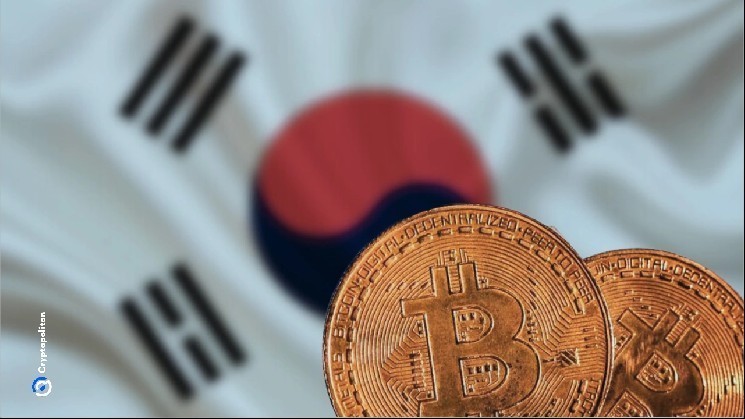
South Korean regulators are considering allowing listed companies and specialized investment firms to invest up to 10% of their capital in cryptocurrencies, potentially double the previous cap of 5%.
The end of a nine-year ban on companies investing in cryptocurrencies was announced on January 11th, but the excitement was short-lived as industry participants expressed disappointment with the quota limits.
Rich Oh, a crypto advisor for Korean companies, told Cryptopolitan that while the move is seen as an improvement, he believes the cap will limit companies’ participation.
He said the 5% cap is not realistic as companies could unintentionally exceed the cap due to price fluctuations or the combined accounting of cash and cryptocurrencies.
“If the price of Bitcoin rises significantly, adhering to the restrictions could force you to sell. Considering that cryptocurrencies are characterized by volatility and constant price fluctuations, this is not a very good rule.”
Rich O suspects that regulators are afraid of publicly traded companies adopting crypto strategies similar to MicroStrategy (MicroStrategy rebranded as Strategy in 2025). The company is the world’s largest corporate holder of Bitcoin, with a reported 650,000 Bitcoins.
He expects the government to raise the cap in the coming years.
Encryption for business survival
Iris (Sungyoung) Park is the co-founder of Korean web3 consultancy DELV and a lawyer specializing in cryptocurrencies. She told Cryptopolitan that there is significant corporate interest in diversifying portfolios with digital assets.
“Today, diversification is absolutely essential for a company to survive. In South Korea, there continues to be a disparity in asset values. This can be seen in the rise in housing prices and the rise in gold prices, but the price of Bitcoin has not skyrocketed.”
He said that many companies in South Korea are not only interested in holding cryptocurrencies, but also holding stablecoins for international trade payments.
“There is a common understanding that cryptocurrencies are a way to keep up with global business.”
But Park doesn’t necessarily agree that authorities are rushing to raise the capital cap as the country looks to establish spot Bitcoin ETF trading as part of its economic growth strategy.
Crypto Infrastructure as a Public Good
KOregon authorities are carefully integrating cryptocurrencies into the financial system. However, there are concerns about increasing asymmetry over ownership of crypto infrastructure. The government’s plan to limit major shareholders’ stakes in cryptocurrency exchanges to 15-20% is controversial.
The Financial Services Commission (FSC) said the cap would help avoid conflicts of interest. FSC Chairman Eog Weon Lee explained that virtual currency exchanges have become a form of public infrastructure, and the cap is necessary to adjust governance standards for virtual currency exchanges to take into account the public role they play.
At a press conference on January 28, Mr. Lee emphasized, “Now that virtual currency exchanges have been officially recognized as part of the financial system, we need to build a governance structure befitting their status.”
The territory of stablecoins
Rich O emphasized that this move is not aimed at user protection, but rather to control the future distribution of the KRW stablecoin.
“Government agencies do not want a small number of crypto exchanges such as Upbit or Bithumb to have too much control over the future distribution of the KRW stablecoin.”
He said the policy was an attempt to weaken the influence of large shareholders.
“They want to diversify their ownership by splitting it up into smaller shareholders and make it easier to negotiate and manage with crypto exchanges,” Rich Oh said.
The proposal could force Chi Hyung Song, co-founder of Dunamu and operator of South Korea’s largest cryptocurrency exchange, to sell his 10% stake in Dunamu’s existing 25% ownership, worth about 3 trillion won.
The ownership cap could also thwart South Korean internet giant Naver’s planned takeover of Dunam, which would see it take control of 100% of Dunam’s shares.
Ownership restrictions go against global standards
This shareholder limit has drawn fierce criticism from the Digital Asset Exchange Alliance (DAXA), which represents South Korea’s five largest cryptocurrency exchanges. They said this restriction would hinder the industry’s growth.
In South Korea’s National Assembly, a group of academics opposed the cap, calling it “excessive” and globally unprecedented.
Yoon Kyung Kim, a professor at Incheon National University, said a diverse ownership base is usually not forced from the beginning, but emerges as a company grows and raises capital.
Innovation is at stake
He said artificially mandating shareholder capital limits could increase management uncertainty, delay large-scale investment decisions, and ultimately weaken national competitiveness and South Korea’s fintech innovation ecosystem.
Cheol Woo Moon, a professor at Sungkyunkwan University, added that forcing shareholders to sell their shares amounts to a violation of the rights of private entrepreneurs and could face legal disputes and constitutional appeals.
Corporate cryptocurrency analyst Rich Orr doesn’t think the proposal will gain traction. However, FSC Chairman Eok Won Lee said he is committed to introducing shareholder restrictions for crypto exchanges.
Sharpen your strategy with mentorship and daily ideas – 30 days free access to our trading program