
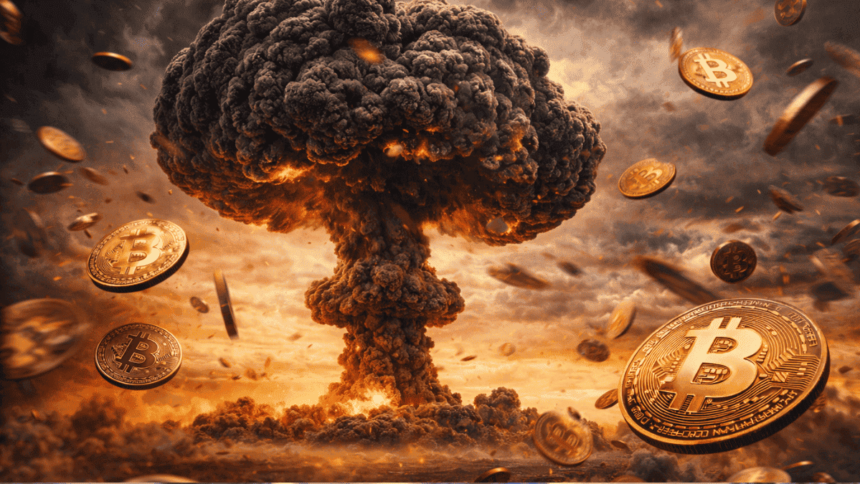
The expiration of the nuclear arms control treaty between the United States and Russia has reignited fears of a new, unstoppable arms race, a scenario that could pose a systemic risk to financial markets, including Bitcoin (BTC) and cryptocurrencies.
On Thursday, February 5, 2026, the New START Treaty came to an end. It imposed verifiable limits on the strategic nuclear weapons of the two major nuclear powers.
Both sides announced the resumption of high-level military dialogue, but the expiry of the agreement leaves the world with no legal framework to limit the number of warheads deployed.
The end of New START marks the end of more than half a century of nuclear cooperation between Washington and Russia, according to an analysis published by the New York Times. The door opens to an era of strategic uncertainty unprecedented since the end of the Cold War.
The end of nuclear restrictions and the risk of escalation
New START went into effect in 2011 and was extended to 2021, limiting the number of strategic nuclear warheads deployed by each country to 1,550 and establishing mechanisms for inspections, data exchange, and mutual notification.
It also capped the number of deployed and non-deployed nuclear-capable intercontinental ballistic missile launchers, submarine ballistic missile launchers, and heavy bombers at 800. Upon completion of New START, these limitations will disappear.
The United States and Russia concentrate approximately 87% of the world’s nuclear weapons, with total inventories of deployed and stored warheads estimated at more than 5,000 warheads each. no verifiable limits Stoke fears that the expansion of these weapons will acceleratein a situation where China is also increasing its nuclear capabilities without being subject to a similar agreement.
Currently, the Asian country has around 600 nuclear weapons, of which only 24 are deployed and the rest remain in storage.
The Bulletin of the Atomic Scientists responded by advancing the Doomsday Clock to just 85 seconds to midnight, reflecting the worsening strategic balance. This is the closest we have come to a global catastrophe since our inception.
Trump, Putin, and the fragile dialogue
US President Donald Trump has expressed a desire to reduce nuclear weapons in the past, but the New York Times warns that his recent actions tell a different story. The administration reduced its diplomatic staff specializing in nuclear control and did not formally respond to Russia’s offer to continue respecting the treaty’s limits after it expired.
This opposition on the part of the United States is, in part, a reaction to the fact that China refuses to join the trilateral agreement. “China’s nuclear capabilities are by no means at the level of the United States or Russia. Therefore, China has no intention of participating in nuclear disarmament negotiations at this time,” said Zhen Sheng, China’s deputy ambassador at the United Nations’ European headquarters in Geneva.
However, after the agreement expired, the United States and Russia announced the resumption of high-level military dialogue, which was interpreted as an attempt to avoid immediate escalation.
The Department of Defense emphasized that while there is currently no new treaty to replace New START, maintaining open channels is “key to stability and de-escalation.”
What impact will this have on Bitcoin and financial markets?
History shows that high levels of geopolitical tensions often result in increased risk aversion, increased volatility, and portfolio reconfiguration. The potential for a nuclear arms race poses This is a source of extreme uncertainty affecting growth expectations, international trade and financial stability.
In these types of scenarios, investors typically reduce their exposure to risky assets in favor of liquidity and traditional safe assets, at least in the short term.
This is related to Bitcoin. Because in the last few months, Narratives as a refuge asset against episodes of geopolitical uncertainty are losing power And in many cases, they have behaved like assets that are sensitive to risk appetite.
As reported by CriptoNoticias, President Donald Trump’s announcement at the end of January regarding new trade tariffs for Europe reintroduced macroeconomic pressures to the market, impacting not only BTC but also several cryptocurrencies.
Tariffs that make trade more expensive and increase global uncertainty have historically coincided with corrections in financial markets and Bitcoin.
As a result of these macroeconomic turmoil and geopolitical tensions, the first few days of February BTC has fallen below the all-time high (ATH) reached during the previous bull cycle in November 2021..
In an extreme scenario of escalating tensions between the US and Russia, the initial impact could be bearish for BTC, at least in the short term, due to a sharp increase in fear and the search for liquidity. However, if confidence in the traditional financial system is undermined, The story of BTC as a safe-haven asset could be reinvigorated.
It is necessary to take into account that a large-scale military competition between the two countries will probably create a deficit (due to an increase in the military budget), but this will be easily solved by an increase in monetary emissions (according to the usual pattern). This is a direct catalyst for Bitcoin in the medium to long term, as digital currencies stand out as a hedge against the inorganic issuance of fiat currencies.
The end of New START does not mean an imminent explosion, but it does mean the end of the scaffolding that for decades has helped reduce the risk of misunderstandings and accidental escalation. As the New York Times points out, Treaties do not guarantee peace, but they do provide visibility and predictability in areas where mistakes can be fatal.
For markets, this new scenario acts as a “potential black swan,” a low-probability but potentially high-impact risk. Their mere presence is enough to influence investor behavior and raise alarm in a global environment already marked by trade tensions, restrictive financial policies and regional conflicts.
Decisions will depend on the direction of dialogue between Washington and Moscow in the coming weeks. Will this risk continue to be contained, or will it begin to influence global financial trends more strongly?