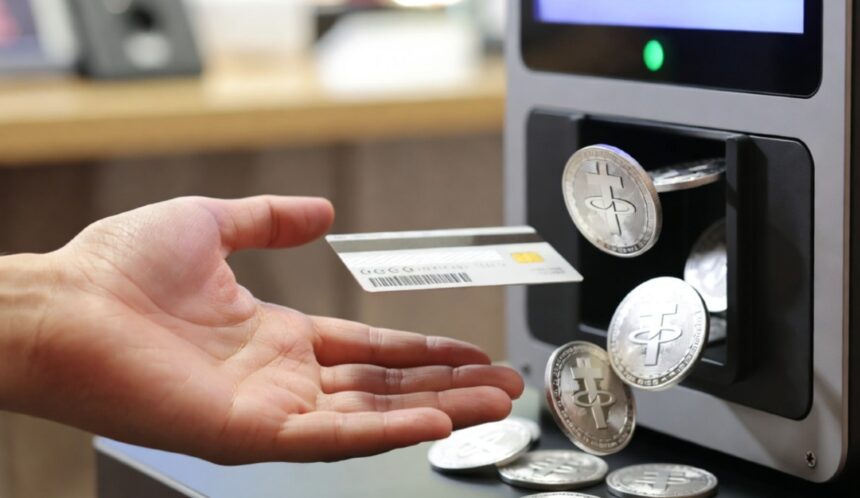
Venezuela is currently registering financial operations called “exchange bicycles” and “quota scrapers” that are reminiscent of dynamics seen in 2014 and 2015. Currently, this problem occurs because there is a difference between the cost of acquiring the currency at national banks and the exchange price of the stablecoin USD Tether (USDT) on person-to-person (P2P) platforms.
New “exchange bicycle” process Based on arbitration cycle In this case, the user obtains an average of 430 bolivars of foreign currency (virtual only) at a national bank and transfers it to an international debit card issued by a local bank. Then use these cards to recharge your virtual wallets like Zinli or Wally and use them to buy USDT on Binance. The company then sells these assets on the P2P market at higher rates, with prices ranging from 570 bolivars per USDT, according to P2P.Army data.
By liquidating digital assets, operators will be able to obtain bolivar surplus and resume purchases with their banks. This will help you instantly understand the difference in profits This reminds me of the old assignment “scraper”.
Dollar liquidity is not guaranteed and users should take into account that there is a purchase limit of $1,000 per day, $4,000 per month, and $8,500 per year. Additionally, allocations are most often given in virtual dollars.
This scenario occurs in the following situation: Some banking institutions in Venezuela accept dollars. This is a product of foreign exchange flows from the sale of crude oil through agreements with the United States.
What is a “quota scraper”?
The practice described above is reminiscent of the so-called “raspadera” or “raspa quota.” This consisted of the use of credit cards with quotas of foreign currency allocated for international consumption.
This was carried out under the program of now-defunct Venezuelan organizations such as the Currency Control Commission (CADIVI) and the National Center for Foreign Trade (CENCOEX). The intention is Get money or “quota” in cash and take advantage of exchange differences. For this reason, the beneficiary simulates a purchase at a point of sale abroad and instead cash.
These amounts range from 300 USD to 5,000 USD, depending on the destination of your trip. Many of these “scratch cards” are manufactured in Cuba, where in 2014 there was a huge influx of Venezuelan tourists looking to get tickets for cash.
It is important to emphasize that these activities are classified as illegal foreign exchange and electronic fraud. This practice has had serious legal consequences when it was on the rise, such as in 2014.
During this period, arrests were recorded for fraudulent use of credit cards and quotas given by the state. and documented cases of citizens being arrested by authorities at airports and banking institutions; He has been charged with illegally obtaining foreign currency.
Pay money “just for sinners”
In a conversation with CriptoNoticias, P2P market trader and expert Daniel Pelaez analyzed the exchange phenomenon occurring in Venezuela from an educational and conceptual approach.
Pelaez asserted that “if a person buys electronic dollars at a rate close to the official rate, exchanges it for USDT, and then sells it on the P2P market at a higher rate, he will technically be facing an operation that can be classified as arbitration.”
But economists also explore concerns raised by the visibility of these practices, which they understand to be speculative. For the health of Venezuela’s digital ecosystem.
What worries me is that given the strategy of banks like Bank of Venezuela, which today offers cards to buy electronic dollars, people are taking advantage of that opportunity to buy dollars at the official rate, take those dollars to the crypto market and convert them to USDT, and then sell that USDT back to bolivars through P2P platforms and capture the difference. The problem is that it’s not being done by people dedicated to arbitration, but by a group of people speculating. And if there’s massive, notorious speculation going on, obviously that can set off alarm bells.
Daniel Andres Pelaez, Venezuelan economist and trader.
Mr Pelaez warned of the situation, which has caused a lot of “noise” in recent weeks: May lead to tool closure It is also essential for other purposes. As you can see, the government can restrict P2P platforms and force Venezuelans to pay money “only to sinners.”
“Ultimately, it will be the people who do P2P, the people who use P2P as a tool to solve the problem of digital money exchange, who will suffer,” he lamented.
Arbitration methods not recommended
Mr. Pelaez concluded his analysis by stressing that he does not recommend this cycle of arbitration work in Venezuela. Because according to his vision, It will pose challenges to the sector.
“I’m not personally recommending that arbitration cycle, because we know this will cause problems for us, and the larger it gets, the more worrying it becomes,” he stressed, recalling that: Some people are already talking about it on social media.
“A lot of people are saying, ‘Look, do it this way, convert it on this platform,’ but that’s where it gets complicated and that’s where I’m a little wary,” he added.
Bike exchange is starting to pick up speed in Venezuela. Despite the risks, the use of multiple tools to circumvent state regulations is becoming the norm.
For analysts like Pelaez, this puts at risk the entire ecosystem that Venezuela has managed to establish. But it’s a dynamic that takes off due to decisive factors. This is the use of bolivars as a spending instrument and USDT as a form of savings.
All of the above has put pressure on the demand for stablecoins or “hard” currencies, with Venezuelans determined to go out in search of them. Even in the digital field.