
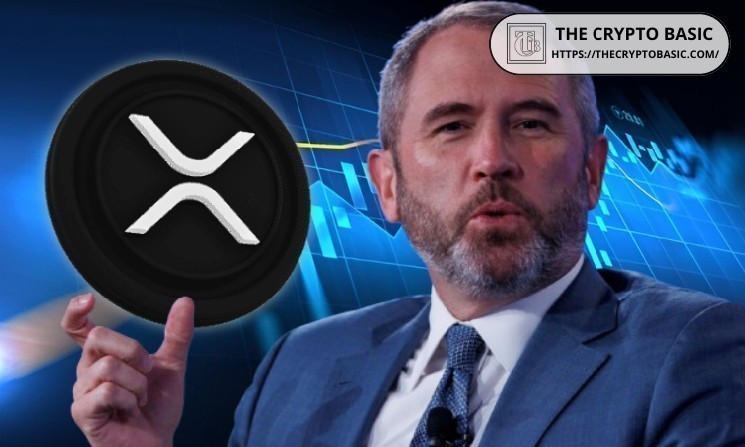
Ripple CEO Brad Garlinghouse said the company’s recent acquisitions $XRP ecosystem.
In particular, he said all moves are aligned with long-term growth. $XRP ledger. Garlinghouse shared this information while speaking at the New York Economic Club’s Digital Payments Series Luncheon.
He explained that Ripple’s expansion strategy is not haphazard. Instead, it focuses on building infrastructure and improving utility. $XRP and $XRP Ledger (XRPL).
According to him, “Our acquisition was certainly very strategic in terms of doing more to improve our overall bottom line.” $XRP He added: $RLUSD Deeper on-chain liquidity plays a key role in that strategy, as it benefits the developers, institutions, and users building on the network.
Important points
Ripple CEO Brad Garlinghouse said the recent acquisitions are strategically strengthening. $XRP ecosystem.
Speaking at the New York Economic Club, he emphasized long-term global growth. $XRP and $XRP ledger.
Garlinghouse said Ripple’s bank-first strategy positions Ripple as a critical infrastructure for global cross-border payments.
he emphasized $RLUSDIts role is to increase on-chain liquidity and support developers and institutions building on XRPL.
Ripple strategic acquisition
It also acquired custody companies Metaco and Palisade to enhance asset security for institutional investors, and acquired stablecoin platform Rail to expand its on-chain payments and liquidity capabilities. According to Ripple’s CEO, these efforts: $XRP‘s appeal.
Ripple’s bank-first strategy
During the discussion, Garlinghouse reflected on Ripple’s early decision to target banks as key customers. At a time when much of the crypto industry was trying to pit itself against traditional finance, Ripple took what he called a contrarian and controversial approach.
From the beginning, Ripple focused on financial institutions as a distribution channel for blockchain-based payments. The logic was that banks would continue to be the primary touchpoint for billions of people using financial services. In order to bring blockchain technology to the widest number of users, integration with banks is essential.
While this strategy may have drawn some initial criticism, it has since positioned Ripple as a major infrastructure provider for cross-border payments.
Regulatory clarity remains important
Garlinghouse also emphasized the importance of regulatory clarity. By clearly defining what constitutes a crypto asset, currency, security, or product, major financial institutions will be able to approach digital assets with more confidence.
He suggested clearer rules would allow more institutions to participate and accelerate adoption across global markets.
Cryptocurrency winter as a reset
While Garlinghouse acknowledged that the crypto market experienced a crypto winter, he said the downturn was a constructive reset.
In his view, the market correction is forcing companies to sharpen their focus, hone their value propositions and prioritize solving real-world problems. He noted that historically, each recession has ended up making the industry stronger and more mature.
$RLUSD liquidity $XRP ledger
Notably, Garlinghouse emphasized that $RLUSD As part of Ripple’s broader ecosystem strategy. By increasing on-chain liquidity, $RLUSD Improves overall efficiency and ease of use. $XRP ledger.
He explained that increased liquidity will enable developers to build decentralized applications and institutions that leverage blockchain for payments and payments.
Ultimately, Ripple is focused on strengthening the company as it continues to expand through strategic acquisitions and infrastructure upgrades. $XRPWhile strengthening the role of in institutional finance, $XRP Ledger ecosystem.