

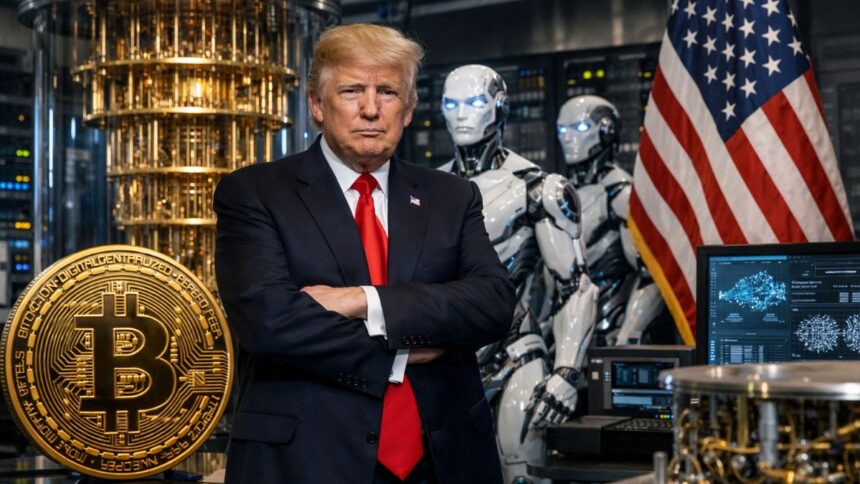
President Donald Trump’s administration announced its National Cybersecurity Strategy through a letter issued by the White House, explicitly mentioning cryptocurrency security, blockchain, post-quantum cryptography, and agent-based artificial intelligence (AI) as national security priorities.
The strategy, published on March 6 this year, devotes a large part of the document to artificial intelligence.
The letter promises to introduce “cyber tools that utilize AI.” To detect, deflect, and deceive threat actors» And to extend the defense of federal networks, we will employ agent AI, a system that can autonomously make decisions and take actions without continuous human intervention.
“We will rapidly deploy and advance agent AI in ways that securely scale network defense and disruption,” the text states.
At the diplomatic level, the strategy states that the United States will work to ensure that generative and agentic AI “advances innovation and global stability” and will ensure the data, infrastructure, and models that support U.S. leadership in the technology.
The document also contains statements with a geopolitical tone.Condemn and block the expansion of foreign AI platforms “It censors, monitors, and deceives users.”
Cryptocurrency: An asset to protect, not a threat to manage
This strategy frames cryptocurrencies as follows: Assets to be protected within the U.S. technology supply chaina different approach from that historically taken by U.S. regulatory documents, which have tended to place them on the same level as data centers and AI infrastructure and treat them as risk vectors or avoidance measures.
“Ensuring American innovation and protecting the nation’s intellectual superiority will be paramount. “We will build secure technologies and supply chains that protect user privacy from design to deployment, including support for the security of cryptocurrencies and blockchain technology,” the document reads.
However, the document does not specify what specific measures will be taken or which organizations will be responsible for this protection. It also does not mention Bitcoin or any specific crypto assets.
Quantum: From threats to national priorities
When it comes to quantum computing, this document is more concise but powerful, with the strategy stating that it will “accelerate the adoption of post-quantum cryptography and secure quantum computing.”
Post-quantum cryptography is the development of cryptographic systems designed to counter potential attacks performed on quantum computers. Breaking current cryptographic standards Protect everything from banking transactions, digital communications, and official documents to your Bitcoin wallet.
The inclusion of quantum computing in the National Security Strategy reflects that the U.S. government is treating quantum risks as a concrete threat, not just a future threat.
However, the White House letter does not mention specific algorithms or post-quantum systems, nor does it provide quantum technical details.
Donald Trump talks about the pillars of cybersecurity
The strategy consists of six pillars of action. In addition to the pillar dedicated to emerging technologies, which focuses on the topics of AI, quantum, and cryptocurrencies, the letter includes five other points.
- Shape adversary behavior through offensive and defensive cyber operations.
- Promote common sense regulations that reduce the burden of compliance.
- Modernize and secure federal networks.
- Protect critical infrastructure such as power grids, financial systems, and hospitals.
- Develop cybersecurity human resources and capabilities as a national strategic asset.
Quantum, global competition
President Trump’s strategy is not an isolated move. As reported by CriptoNoticias, in September 2025, the U.S. Securities and Exchange Commission (SEC) presented the Post-Quantum Financial Infrastructure Framework (PQFIF). Traditional cryptographic algorithms are no longer secure.
“The U.S. digital asset ecosystem built on current cryptographic standards faces an existential threat from rapid advances in quantum computing,” the SEC warned in its document.
On the other side of the world, China is also making progress. Origin Quantum Computing Technology, a company with ties to the Chinese government, released Origin Pilot in February 2026. Quantum Computing Operating System, Free Public DownloadAccording to state media Global Times, it will be the world’s first publicly available open source quantum operating system.
While the US unveils its defense strategy, China unveils its open quantum infrastructure. These are two different movements in the same global competition.