



Ethereum is currently testing a key resistance level as the broader cryptocurrency market attempts to recover from recent volatility and downward pressure. After several weeks of price correction action, ETH has begun to stabilize, with buyers gradually pushing the asset higher as traders reassess market conditions and liquidity flows across digital assets.
While price action suggests a potential near-term rebound, derivatives market data suggests larger structural changes could be unfolding beneath the surface. According to a recent analysis by CryptoQuant analyst Arab Chain, the ETH Binance Futures Smart Money CVD (90D) indicator has begun to reflect notable changes in demand dynamics within the Ethereum derivatives market on Binance.
This indicator tracks the cumulative difference between aggressive buy orders and aggressive sell orders executed through market orders in the futures market. Because these orders represent traders looking to execute trades immediately, this indicator provides valuable insight into real-time demand pressure from more active market participants.
According to the latest data, Binance’s aggressive buying volume of Ethereum futures recently reached approximately $4.583 billion, and aggressive selling volume totaled $4.576 billion. As a result, the daily Taker Delta recorded a positive value of approximately $7.15 million, indicating a slight advantage for buyers during the session as the market attempted to regain momentum.
Smart Money CVD still reflects prevailing selling pressure.
Despite recent sessions showing a slight advantage for buyers, the broad structure of the Ethereum derivatives market remains tilted towards selling pressure. According to the analysis, the 90-day rolling smart money CVD is still negative at around -$5.71 billion, indicating that aggressive selling activity has outweighed aggressive buying activity over the past three months.

In practical terms, this means that market participants using market orders were more willing to sell Ethereum than to accumulate it during that period. Because CVD tracks the cumulative difference between buy and sell orders executed directly in the market, persistent negative values typically reflect market conditions in which sellers close positions or initiate sell transactions.
However, analysts note that negative CVD numbers do not automatically translate into immediate downward price movement. Market dynamics can sometimes produce different results through a mechanism known as liquidity absorption.
In these situations, a large buyer can place a significant amount of limit orders on the order book, absorbing selling pressure without significantly increasing the price in the short term. This behavior can create a temporary equilibrium in which aggressive sellers continue to outbid and patient buyers gradually build up supply.
If this absorption process continues, it could eventually reduce sell-side pressure and lay the groundwork for a potential shift in market momentum.
Ethereum tests long-term support zone after months of corrections.
The weekly chart shows that Ethereum is attempting to stabilize after a prolonged correction phase that began after being rejected near $4,800 in 2025. After the peak, the price action formed a clear sequence of lower highs and lower lows, confirming a continued bearish structure over the higher period.
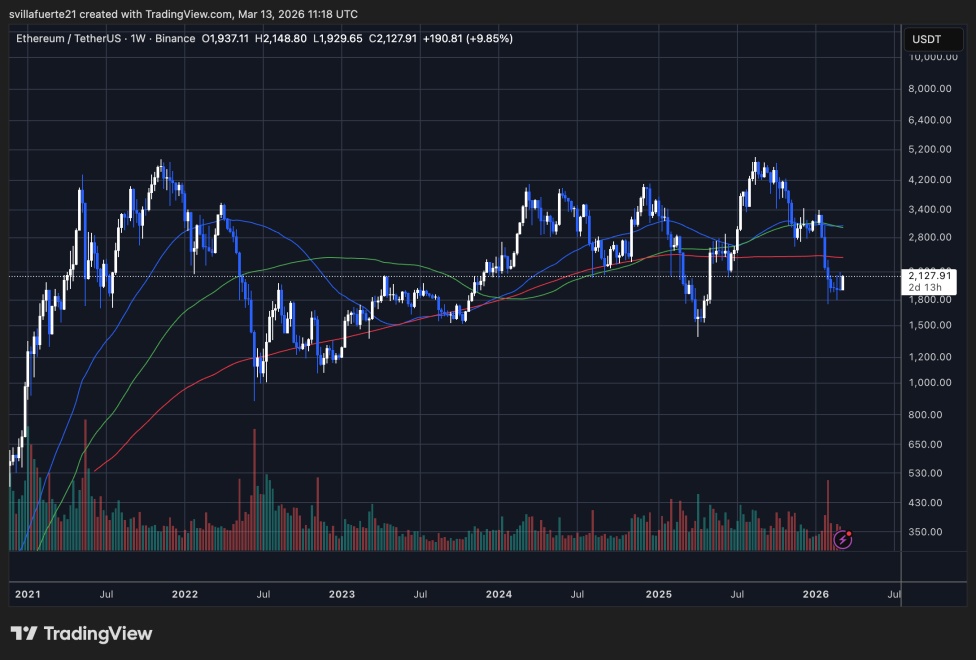
The recent sell-off has pushed ETH sharply below the $2,400-$2,600 area, which served as an important support zone during the previous consolidation phase. This collapse triggered a sharp decline towards the $1,800 level, before buyers finally intervened and produced a short-lived bounce.
Ethereum is currently trading around the $2,100 level, a price area that appears to act as a temporary balance between buyers and sellers. From a technical perspective, this area now serves as an important pivot level. Continued price action above this area could allow ETH to attempt a recovery towards the $2,600 resistance area, around which the 100-week moving average is currently trending.
But the broader structure remains vulnerable. The 200-week moving average is slightly below current prices and could serve as an important long-term support level if selling pressure returns.
Volume data also shows increased activity during the recent downturn, suggesting that the market has undergone a significant liquidation phase. Whether this signals a capitulation or simply a pause in the downtrend will depend on Ethereum’s ability to regain higher resistance levels in the coming weeks.
Featured image from ChatGPT, chart from TradingView.com
editing process for focuses on providing thoroughly researched, accurate, and unbiased content. We adhere to strict sourcing standards and each page undergoes diligent review by our team of top technology experts and seasoned editors. This process ensures the integrity, relevance, and value of the content for readers.