On X, Lekker Capital CIO Quinn Thompson argues that the collapse of the mining economy coupled with a growing shift by public miners to AI and high-performance computing could lead to companies becoming corporatized. $BTC Turn government bonds into a new source of market supply.
“A major underappreciated headwind for Bitcoin is the catastrophe hitting the mining economy. The only way to heal this is through hashrate decline, which is being led by AI computational pioneers like CORZ, WULF, CIFR, and IREN,” Thompson wrote.
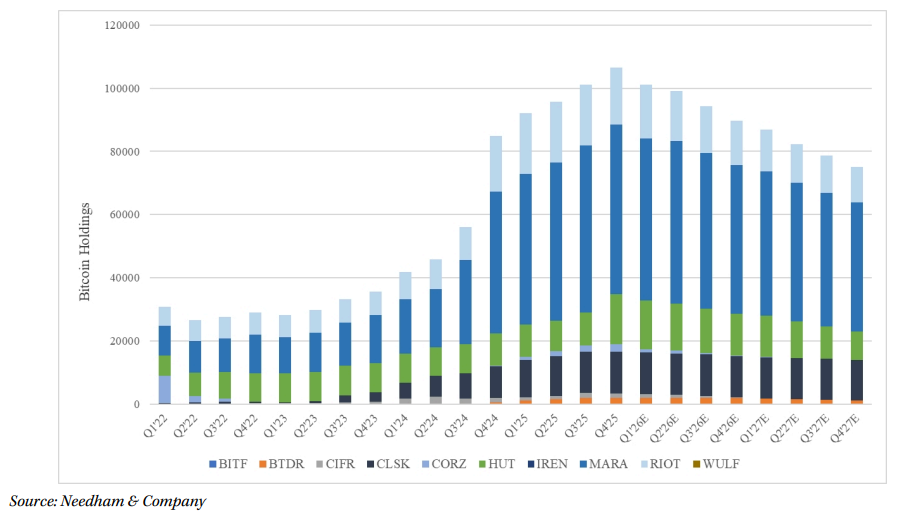
The graph Thompson shared visually illustrates the problem. This shows that the total Bitcoin holdings across all major listed miners will rise sharply from 2024 to 2025, before reversing in 2026. Thompson’s point is not that the AI pivot is structurally bearish.
On the contrary, a lower hashrate and less uneconomic competition could improve the health of the mining industry over time. His point is that the transition itself will be costly, and that capital-intensive AI ramp-ups could force miners into liquidation. $BTC Previously it was treated as the Strategic Treasury.
“While helpful for the long-term health and sustainability of the network economy, Bitcoin miners hold approximately 80,000 Bitcoins on their balance sheets, creating a dilemma for prices in the short term.As these companies pivot away from the network economy, $BTC If they do mining, they 1) need capital to fund the capital investment requirements of building the AI, and 2) there is no reason to hold back on their investment. $BTC It needs to be included in the balance sheet (it should not be included in advance),” he argued.
Bitcoin miners shift focus to AI
2025 filings and public data make that argument more concrete. Core Scientific’s fourth-quarter results showed a shift in business mix away from mining and toward AI-related infrastructure. Self-mining revenue decreased to $42.2 million from $79.9 million in the year-ago period, while colocation revenue increased from $8.5 million to $31.3 million. Management said the decline in hosted mining reflects a “continued strategic shift” to high-density colocation. For the full year 2025, Core generated $402.5 million in revenue from the sale of digital assets, and ended the year with $2,537 in revenue. $BTC It’s on the balance sheet.
TeraWulf provides even cleaner reads. The company said it has “consolidated HPC hosting as a key growth engine” in 2025, signed more than $12.8 billion in long-term customer contracts, and built a platform with 522 significant IT megawatts under contract. But as that construction took shape, the legacy mining business still continued to be monetized. Fourth-quarter digital asset revenue was $26.1 million, compared to HPC lease revenue of $9.7 million, with the company’s year-end digital asset rollforward showing 1,496. $BTC Mining, 1,500 $BTC I got rid of only 3 $BTC It will remain on the balance sheet on December 31, 2025.
Cipher and IREN illustrate two other versions of the same trend. Cipher said it increased its focus on HPC in 2025, signing two HPC tenants for a total of 600 MW of data center capacity. It also sold Bitcoin for approximately $214.7 million in the same year. By the end of the year, Cipher had classified $94.9 million worth of Black Pearl mining rigs for sale after entering into a sublease agreement to transition the site to an HPC tenant. By contrast, IREN has already largely taken Treasury issuance off the table, saying it has approximately 99,900 GPUs installed or on order as of December 31, 2025, and will have no Bitcoin on its balance sheet at the end of the year as it “typically liquidates all the Bitcoin it mines on a daily basis.”
MARA is important for another reason. Although we are not yet as far along as Core, TeraWulf, Cipher, and IREN in terms of transforming our mine sites into full AI/HPC businesses, we have deployed our first 10 AI racks in Granbury by November 2025 and have since announced a Starwood partnership for AI and HPC infrastructure. However, MARA is the Treasury heavyweight within the group and its own 2025 disclosures went in Mr Thompson’s direction. The company announced that it will begin selling Bitcoin in the second half of 2025, with approximately 4,076 units sold. $BTC For the year, it was $413.1 million, but it was still about $53,822 at the end of 2025. $BTC.
That is the tension of Thompson’s paper. The move to miner-driven AI reduces hashrate pressure and improves the long-term economics of Bitcoin mining. But bridging from mining to AI is capital-intensive, and 2025 filings show that this bridge is already funded. $BTC Sales, minor disposals, site conversions. In the case of Bitcoin, this means that industry corrections that may have a constructive effect later may still look like overhangs for now.
At the time of writing, Bitcoin was trading at $72,322.
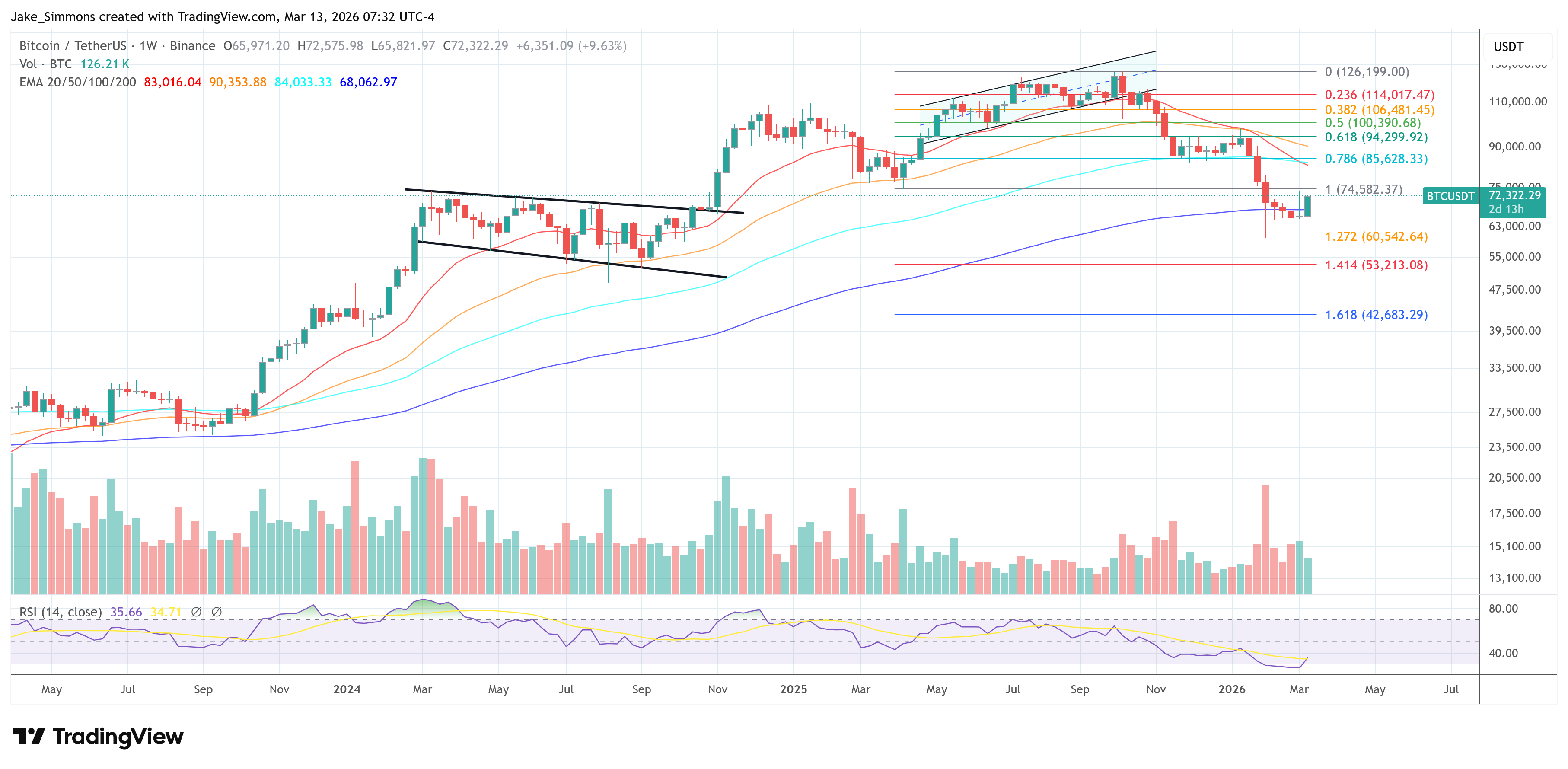
Featured image created with DALL.E, chart on TradingView.com