


The agency called on the government to allow the issuance of digital financial assets on open networks like Ethereum and open up domestic companies to international investment. Russian Central Bank Governor Elvira Nabiullina also said that these regulations will help implement cross-border payments.
Russia establishes digital assets as vehicle for international investment
Russia’s central bank has proposed a set of rules that would allow companies to issue digital financial assets on public networks such as Ethereum.
According to local sources, Russian Central Bank Governor Elvira Nabiullina said these new rules are important for attracting international investment and implementing international payments.
Digital financial assets, which represent financial rights in digital form, are now being issued on domestic platforms where accredited investors can take advantage of these opportunities. However, these reforms will allow anyone to invest in these assets, with the potential for them to be listed on international exchanges and decentralized finance platforms.
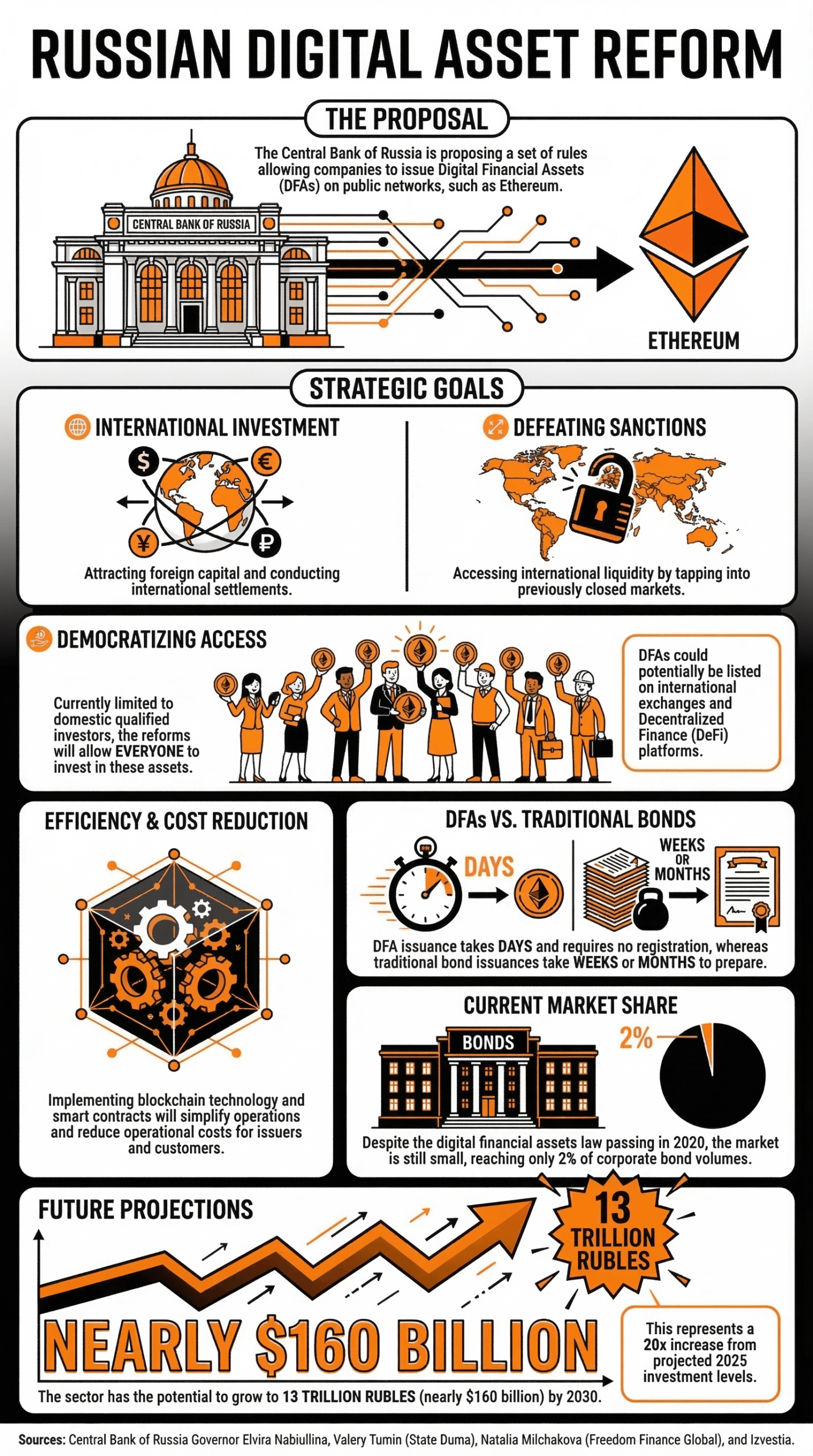
This will allow Russian companies to access international liquidity, enter previously closed markets and bypass sanctions to reach interested investors. Introducing blockchain technology and smart contracts will simplify operations and reduce operating costs for issuers and customers.
Although the Digital Financial Assets Law was passed in 2020, the market for such products is still small compared to the size of the traditional bond market, accounting for only 2% of corporate trading volume, according to Valerie Tumin, a member of the State Duma of the Council of Experts on the Development of the Digital Economy.
Toomin pointed out that banks are actively developing these alternatives because they take days to issue and do not require registration, whereas traditional bond issuances take weeks or months to prepare.
Although there are technical challenges to be addressed, Freedom Finance Global’s Natalia Mirchakova told Izvestia that the sector could grow to 13 trillion rubles, or about $160 billion, by 2030. This would represent a 20-fold increase from the investment level reached in 2025.
FAQ 🔎
- What new regulations is the Russian Central Bank proposing?
The central bank plans to allow companies to issue digital financial assets on public networks like Ethereum to attract international investment. - How will these new rules affect investment opportunities in Russia?
They aim to democratize access to investment, allowing wider participation and the possibility of listing on international exchanges and decentralized finance platforms. - What is the current state of the digital financial asset market in Russia?
Despite the passage of the Digital Financial Assets Act in 2020, the market is small, accounting for just 2% of business volume. - What are the potential growth projections for this sector?
Experts predict that this sector could grow to 13 trillion rubles (approximately $160 billion) by 2030, with a significant increase in investment.