


Bitcoin $BTC$73,886.45 Prices have remained relatively unscathed during the two-week war with Iran. What’s even more impressive is that its key volatility indicator has also remained stable, indicating that crypto traders are less fearful than traders in traditional markets such as stocks, oil, and bonds.
Tensions between Iran, the US and Israel erupted into public conflict on February 28, damaging oil infrastructure and disrupting tanker flows across the Middle East. Analysts warned that the disruption could lead to large price swings and fear-based hedging across asset classes.
So far they are partially wrong.
According to TradingView data, Bitcoin’s 30-day Implied Volatility Index (BVIV) has remained surprisingly stable between 55% and 60%. Since implied volatility reflects demand for options, stability suggests that traders are not actively buying put options to hedge against falling prices.
But traditional market traders are chasing those options out of fear, as evidenced by the spike in their respective volatility indexes.
The stock index VIX, which measures the expected 30-day volatility of the S&P 500 based on option prices, averaged just over 20% before the conflict. It jumped more than 32% on March 6, and continued to rise nearly 26% on Monday.
CBOE’s crude oil volatility index OVX rose from 64% to over 100%. MOVE, which tracks U.S. Treasury volatility, rose from 73% to 85%, at one point hitting a high of 95%, reflecting broader market uncertainty. Traditionally seen as a haven during difficult times, gold’s volatility index has remained steady above 30%.
The divergence between Bitcoin and traditional market indexes is important. Although asset prices can be noisy and subject to volatile flows, volatility indicators can often provide a clear picture of investor sentiment, particularly the need to hedge against downside risk. By that scale, $BTC Traders seem calm.
One possible explanation is that sentiment towards cryptocurrencies was already unstable before the Iran conflict. Bitcoin’s price plummeted from an all-time high of over $126,000 in October 2025 to low $60,000 in the following months, a drawdown that spooked many bulls and forced others to hedge against further declines.
In that context, the Iran war was a bigger shock to crypto markets than it was to stocks and other markets, which had been hovering near all-time highs or flat in the weeks leading up to the conflict.
Since 2020, Bitcoin has averaged double-digit returns over 60 days during multiple geopolitical events, according to an analysis by River, a financial firm specializing in Bitcoin.
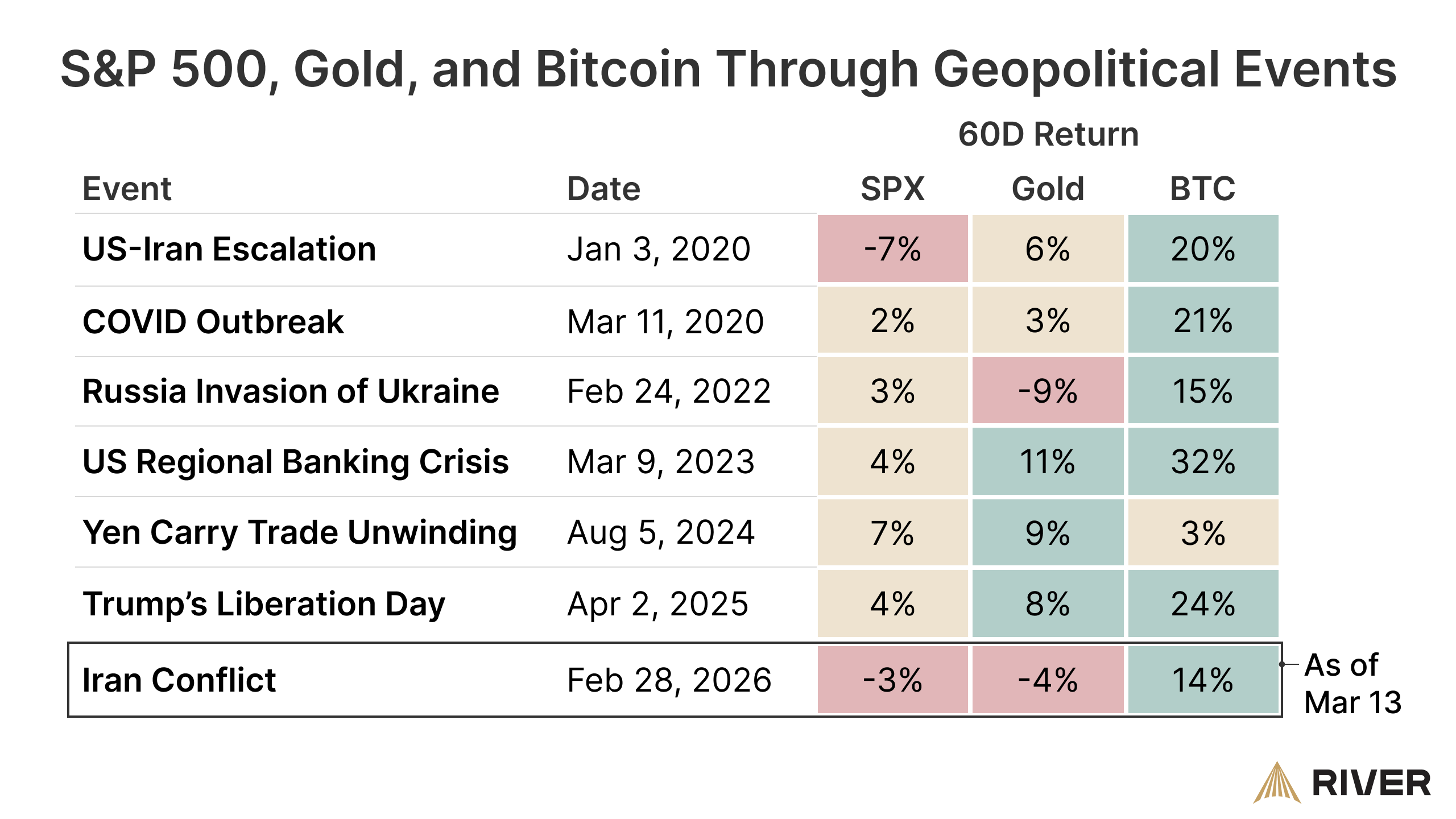
Bitcoin, gold, and S&P 500 performance during geopolitical events. (river)
History repeats itself. Bitcoin has risen more than 10% in two weeks to $74,000, according to CoinDesk data.
All things considered, the message is clear. $BTC It has stabilized when it matters most. It remains to be seen whether stability will continue.