
The private credit market is facing increasing pressure as investors grow concerned about how AI will affect software companies’ revenue streams.
Experts suggest that job losses due to AI, increased private credit stress, and tightening lending conditions could ultimately leave governments with little choice but to print money, a scenario that could have a significant impact on Bitcoin ($BTC).
Signs of increasing stress across private credit markets
Morgan Stanley predicts that direct loan default rates could rise to 8% due to artificial intelligence disruption in the software industry.
At the same time, Fitch Ratings’ US Private Credit Default Rate (PCDR) rose to 5.8%. This was the highest level since August 2024. Stock prices of major private credit management companies also plummeted.
The private credit default rate has just reached 5.8%.
Apollo is down 41%. Blackstone fell 46%. Blue Owl is down 66% from its peak.
$265 billion in market capitalization disappeared. This is not a headline. It’s a crisis. pic.twitter.com/Am5fwWlQPj
— Michael A. Gayed, CFA (@leadlagreport) March 16, 2026
BeInCrypto also reported that five major private credit fund managers have capped or restricted investor withdrawals since late February. Concerns were also compounded when the US Business Development Corporation Index (MVBDC) fell to multi-year lows in late February. These signs point to deepening stress across the sector.
In the case of Bitcoin
Macro analyst Luke Gromen suggested the U.S. financial system could be forced to print more money within three to six months. Pressures he cites include job losses due to AI, private credit stress and reduced lending liquidity.
“We know that the whole system is highly leveraged, and we know that as a government, as a federal government, we have record revenues. We’re barely covering our entitlements and our interest payments. Any kind of recession will force us to default on our treasury or entitlements or print money. And they’ll print money,” he said.
“All of this is like a money printing machine.” – Brandon Quitem
War, private credit risk, job losses due to AI, Japan’s dealings with emerging markets, and political pressure for midterm elections.
That is the macro background on which Bitcoin was built. 👇 pic.twitter.com/fhFxCPj7Fp
— Swan (@Swan) March 16, 2026
As more money is printed, Bitcoin could be one of the beneficiaries as investors move their money into rare non-sovereign assets to escape currency devaluation. What makes this moment particularly interesting is that Bitcoin is no longer just a theoretical hedge. It has already been proven in real time.
While traditional markets have struggled under the weight of geopolitical tensions, $BTC Since the Iran conflict escalated on February 28, the company has gained 10.87%, outperforming the S&P 500, Nasdaq 100, gold, and silver over the same period.
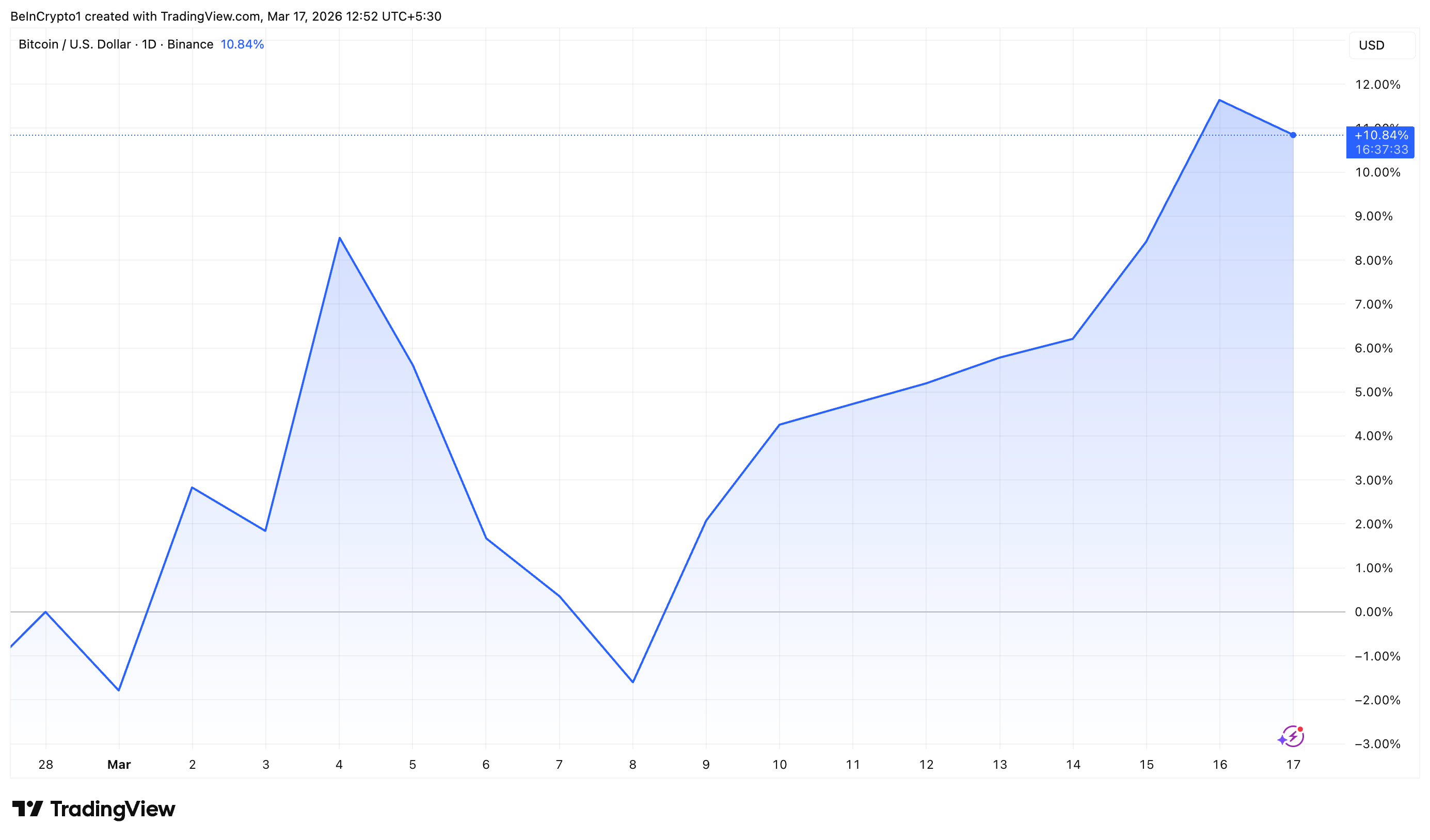
Bitcoin price performance since the US-Iran conflict. Source: TradingView
Given both the potential liquidity crisis and geopolitical instability, Bitcoin’s setup looks increasingly attractive.
The post Macro Analysts Warn of Credit Crisis: A Scenario Built for Bitcoin? appeared first on BeInCrypto.