



Ethereum continues to struggle below the $2,000 level as continued selling pressure and heightened uncertainty weighs on broader cryptocurrency market sentiment. Despite intermittent rebound attempts, price action remains fragile and volatility remains elevated after months of corrective momentum. The inability to decisively recover from these psychological thresholds has further intensified traders’ caution, especially as liquidity conditions tighten and macro uncertainties continue to affect risk appetite across digital assets.
Darkfost’s latest analysis adds additional context to the current market structure. According to the data, the ongoing correction is currently affecting all investor groups, including the largest holders of Ethereum. In particular, Whale Group’s unrealized profit margin has overall shifted into negative territory. Wallets holding 1,000 to 10,000 ETH have an unrealized profit margin of around -0.21, while wallets holding 10,000 to 100,000 ETH are closer to -0.18. Even the largest group holding over 100,000 ETH fell into negative territory around -0.08.

This development is noteworthy as Ethereum has yet to revisit its April lows, suggesting that the depth of unrealized losses is widening earlier than some previous corrections. These conditions may increase market sensitivity. This is because even traditionally resilient holders may reevaluate their positioning amid prolonged volatility.
Whale stress increases the risk of surrender during bottom formation signals.
Darkfost added that if Ethereum extends its downtrend, large holders could face increased financial pressure. A continued downturn could deepen unrealized losses across the whale population, potentially forcing some participants to reduce exposure or liquidate their holdings. Historically, such capitulation events among large investors tend to amplify short-term volatility, especially when liquidity conditions are already weak.
However, despite the negative profit margins currently seen across groups of whales, Ethereum has recently stabilized above its local support zone. This relative resilience suggests that an immediate large-scale distribution of whales has not yet been realized, although sentiments are cautious. The distinction is important because unrealized losses alone do not necessarily trigger selling, unless they are accompanied by liquidity stress, leverage pressures or broader market shocks.
Periods of stress experienced by major holders often coincided with the mid-term bottom formation phase of the previous cycle. As weak hands exit and leverage is unwound, the market sometimes transitions into an accumulation regime characterized by low volatility and gradual stabilization.
However, this interpretation must be approached with caution. Whale positioning is only one element of market structure and confirmation will typically require improved liquidity, stronger spot demand, and supportive macro conditions before a sustained recovery takes place.
Ethereum price structure remains unstable below major averages
Ethereum continues to trade under clear technical pressure, with weekly charts showing its continued inability to decisively regain the $2,000 region. After sharply rejecting the 2025 high near $4,800, price action devolved into a series of lower highs and weaker rallies, which are typically associated with a corrective market phase rather than an accumulation-led recovery.
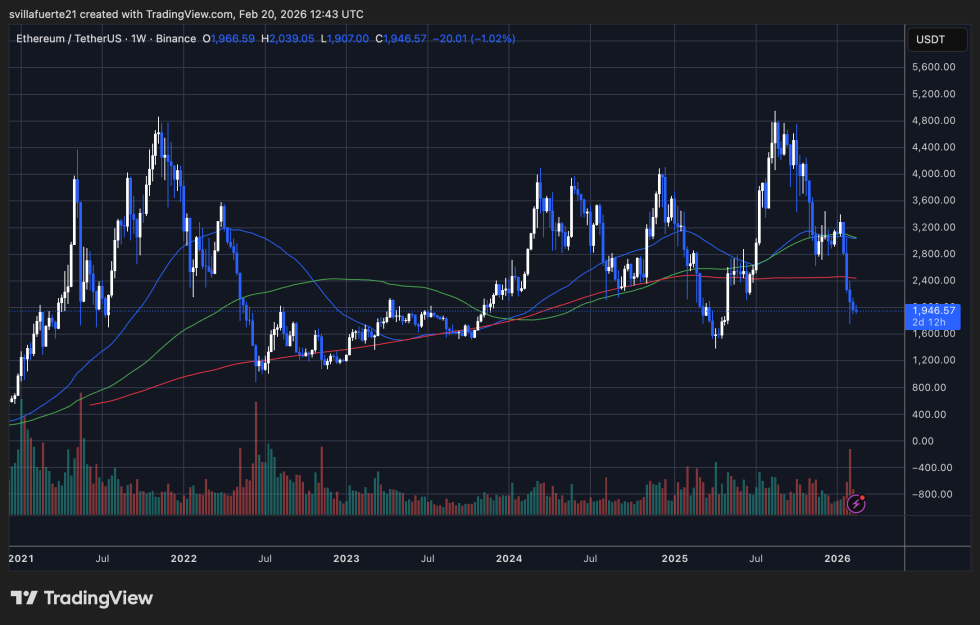
Technically, ETH is currently positioned below several key moving averages that previously served as dynamic support. This level now acts as resistance, limiting attempts to the upside unless expanding volume triggers a strong bounce. The recent decline towards the $1,900 level reflects continued selling pressure, while repeated failures near the mid-$2,000 range reinforce cautious market sentiment.
Volume activity has moderated compared to the impulsive rally phase, suggesting reduced speculative participation. A drop in volume during a correction can be a sign that sellers are tired, but confirming stabilization usually requires sustained buying interest rather than a temporary bounce.
From a structural perspective, immediate support appears to be centered near recent local lows near $1,800, with resistance hovering roughly between $2,200 and $2,600. Until Ethereum convincingly regains these levels, the broader technical outlook remains fragile and consolidation or further declines remain plausible.
Featured image from ChatGPT, chart from TradingView.com
editing process for focuses on providing thoroughly researched, accurate, and unbiased content. We adhere to strict sourcing standards and each page undergoes diligent review by our team of top technology experts and seasoned editors. This process ensures the integrity, relevance, and value of the content for readers.