

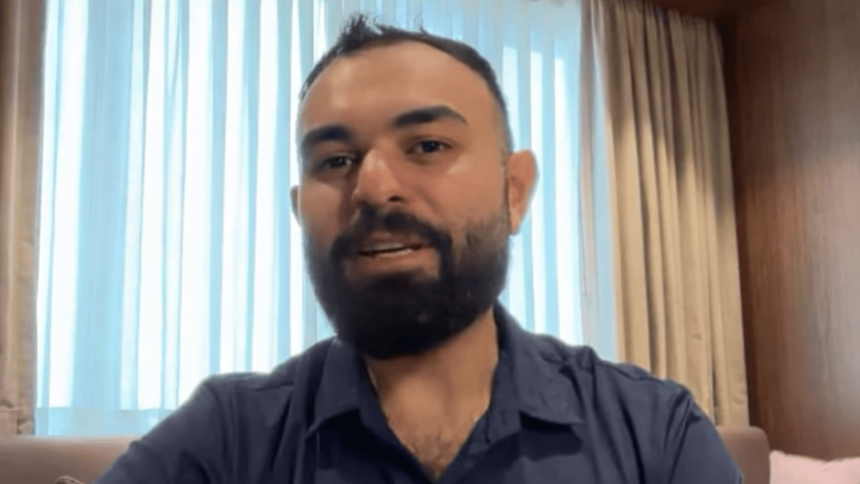
The phrase that gives this publication its title is not intended as a stand-alone prediction or a market slogan launched in the heat of the moment, but as part of a broader look at the present and future of the digital asset industry.
The person who made this statement was Vugaa Usi Zadeh, chief operating officer Mexican joint venture (COO). In a written interview with CriptoNoticias, the executive reflected on his career, his entry into the ecosystem, his vision for the exchange’s growth, and his view that Bitcoin (BTC) will continue to be a “structural pillar of the entire digital asset market.”
According to the story, his personal story is not that dissimilar to that of many names resonating in this ecosystem. “I came to the crypto world through a completely different path than most people,” he says. His academic training was received at institutions such as Harvard University and Oxford.
And his professional career evolved within “large organized organizations,” achieving executive positions at Fortune 500 companies such as Sony, Carlsberg, and Facebook. That step, he says, gave him a deep understanding of “global operations, brand building, and how to scale a product to hundreds of millions of users.”
There is also an explanation for this route How he approaches Bitcoin. He asserts that it is not due to speculation or the search for quick economic opportunities..
“Bitcoin offers something fundamentally different.”
“Unlike many people who entered cryptocurrencies looking for quick profits, my entry point was more realistic,” he points out.
By that time, he was already a “start-up success” and had some financial security. Therefore, in your case, The focus was on “capital conservation and liquidity.”
In his research, he found that while “traditional financial rails were slow, expensive, and sometimes limited,” “Bitcoin offered something fundamentally different: the ability to move value around the world with speed, transparency, and full ownership.”
As he tells it, the experience went beyond the conceptual level. “My first real use of Bitcoin was for international money transfers,” he explained, adding that it was “transformative.” The reasons, he says, went beyond the effects of the transfer.
It wasn’t just about the deal itself, but also about the underlying philosophy of self-management and fiscal sovereignty.
Vugar Usi Zade, Chief Operating Officer (COO) of MEXC, said:
At this point, one of the most personal definitions of the entire interview emerges. “For the first time, I felt that what I earned was truly mine and not subject to the limitations and control of traditional systems.”
That understanding means that technology does not just represent a new asset class; “Tectonic changes in how people access, move, and store value.”
behind the scenes of businessman
From his current role at MEXC, Usi Zade combines his beliefs with the challenges of business expansion and the development perspective of the sector. Reminiscing about his time at a large company, he summarizes one of the core lessons he imparted to the Web 3 world: “Scale is never a coincidence.”
In your reading, Growth does not depend on luck or isolated campaignsbut requires “disciplined systems, clear communication, and coordination” within complex organizations. This idea, taken from the traditional business world, takes on special significance in what he describes as a “much newer and more volatile” industry.
His comparisons between both worlds are graphic. While traditional companies operate on a model of “continuous and incremental improvement,” the digital assets sector “often feels like building and improving an airplane that is already flying,” he argues.
That side There is a persistent tension between speed and structure.. Growth can be explosive and products need to evolve in real time, but “without structure, speed quickly turns to chaos.” That’s why he insists on three principles he considers fundamental: “The three most important lessons I learned from traditional business to Web 3 are collaboration, coordination, and communication.”
His previous presence in Biggett also plays an important role in the story. There, he recalls, he was part of a project that grew the platform “from about 11 million users to more than 120 million” until it became one of the world’s largest exchanges.
Asked about the formula behind that growth, he declined to attribute it to a single tactic. “Growth like this doesn’t come from a single marketing strategy or campaign,” he says. Rather, he describes it as “clarity of direction, bold decisions at the right time, and a willingness to invest when others are retreating.”
Still, he identifies some guiding ideas. “If there’s a ‘secret formula,’ it’s the ability to identify true north and build an entire organization around it.”
In that sense, we highlight investments made during adverse market times, such as our $30 million spend on what later became Bitget Wallet and our support of ecosystem initiatives such as the TON Foundation.
The learning extracted from this process is summarized in another phrase with a programmatic tone:
By building around a long-term vision rather than market cycles, you can create products and organizations that survive those cycles.
Vugar Usi Zade, Chief Operating Officer (COO) of MEXC, said:
MEXC maintains this logic, but has an even more ambitious vision, he says. The goal is to “turn exchanges into universal access points to digital and tokenized assets.” Therefore, when talking about the company’s roadmap, he claims that “2026 marks a decisive evolution for MEXC.” He explained that the company aims to become “more than a listing-first exchange and a gateway to global tokenization opportunities.”
In his words, this transition includes: Expanding focus from cryptocurrencies to “tokenized stocks, commodities, and any assets that can be moved on-chain”.
What would you change about the cryptocurrency industry?
At this point, Usi Zade introduces a critique of the cultural climate that, according to him, still dominates significant parts of the field. “If I could change one thing about this industry, it would be to focus on short-term profits,” he says.
In his opinion, The public conversation about Bitcoin and cryptocurrencies is still too conditioned by get-rich-quick storieswhen the real possibilities lie elsewhere. “The real promise of this industry lies in its ability to expand financial access, reduce friction in global trade, and give individuals greater control over their assets.” To him, these are “structural improvements to the financial system, not just trading opportunities.”
Bitcoin long-term outlook
Seen from that perspective, his predictions for Bitcoin for the remainder of the current cycle fit into the broader picture. “From my personal perspective and from what I have observed at MEXC, Bitcoin continues to serve as a structural anchor for the overall digital asset market,” he says.
According to Usi Zade, Bitcoin is “an asset that defines sentiment, liquidity cycles, and institutional confidence.” Therefore, all reading about the industry as a whole “ultimately starts with Bitcoin.”
When reviewing an asset’s past performance, we refer to a “well-defined” cycle that is influenced by macroeconomic factors, liquidity, and supply dynamics related to half-life.
Although he clarifies that predicting the exact timing of the all-time high is uncertain, he maintains that the overall trajectory is “consistently upward” as Bitcoin’s adoption grows and its integration into the global financial system increases.
In this framework, he formulates a basic scenario. “Bitcoin could approach the $150,000 level towards the end of 2026.”. “If institutional inflows, ETF adoption, and global liquidity conditions remain favorable, a realistic scenario would be to move towards the $200,000 level in early 2027,” he added.
But he insists his confidence is not driven by short-term prices. “What gives me confidence over the long term is not short-term price movements, but Bitcoin’s role as a new form of digital reserve asset.”
Despite cycles and volatility, the asset has “consistently recovered, reaching new highs and attracting a wider range of users and institutions at each stage,” it said.
So, while making clear that “no predictions should be treated as financial advice,” he concludes on a decidedly positive note: “Bitcoin, in my opinion, remains the core asset of this industry and one of the most important financial innovations of our time.”