


Bitcoin’s hash rate remains below the 1 zetahash per second (ZH/s) standard, and the daily hash price rate remains at $31 per petahash per second (PH/s), as miner income remains painfully thin.
Weak hash price and low compute
Bitcoin’s hashrate briefly exceeded 1,000 exahashes per second (EH/s) (the neat mathematical twin of 1 ZH/s), but has since fallen back below that line. The move comes as the value of one petahash of output remains at $31.11, a decline of approximately 11.64% compared to 30 days ago, on February 15, 2026.
Although the return is still small, it is 12.88% higher than the hash price of $27.56 recorded on February 24th. At the time of writing, the network’s hash rate is hovering between 960 and 970 EH/s, and the block interval has increased to approximately 10 minutes and 42 seconds, likely setting the stage for a difficulty reduction scheduled for March 20, 2026.
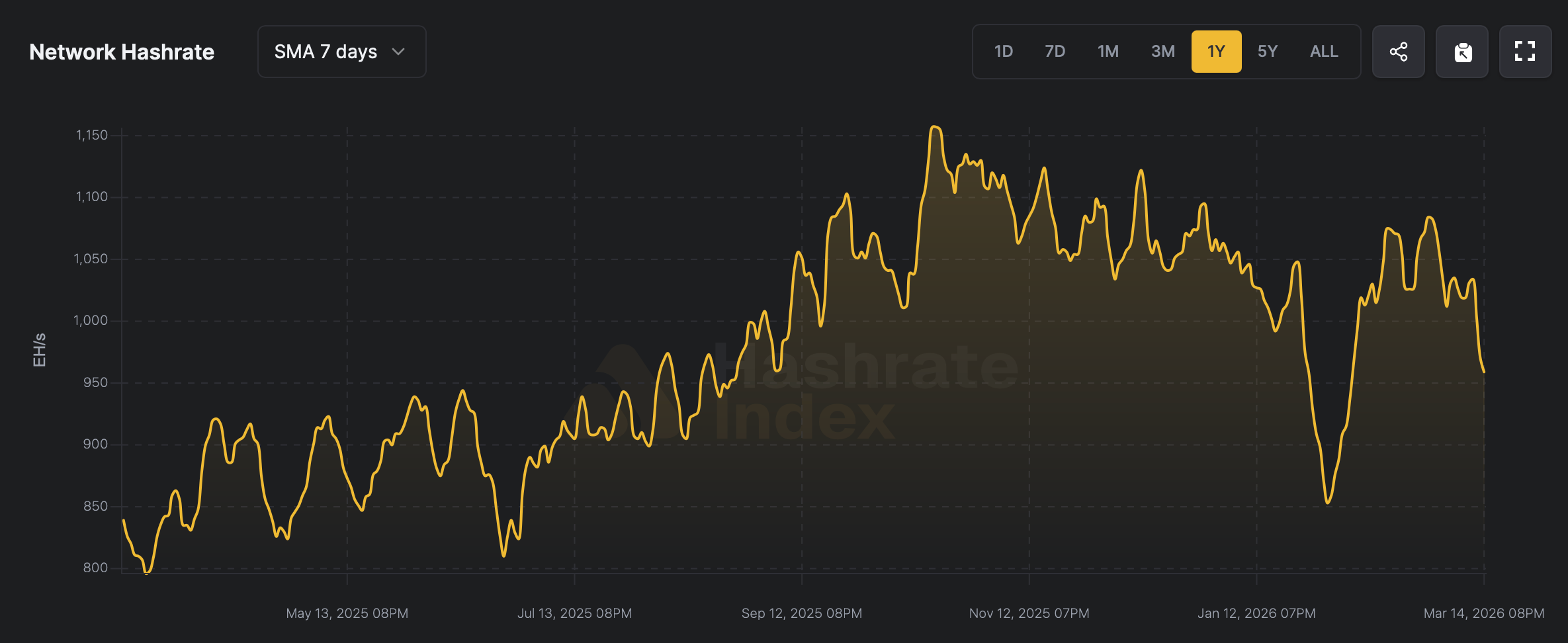
Image source: hashrateindex.com
This adjustment is currently estimated to be about 6.57% below today’s levels, but there is a tendency for forecasts to change minds. Miners have already endured two consecutive difficulty increases, including the biggest increase since 2021. After that shocking 14.73% increase, the difficulty rose again on March 5th, with a modest increase of 0.45%. Pulling back will remove some of the heat.
Overall, 2026 will bring paper-thin margins for Bitcoin miners, with hash prices remaining below pre-2016 levels. If the expected difficulty reduction holds, miners may finally be able to take a break after weeks of tight margins and erratic block production. Still, the relief could be temporary if the situation improves and hashing power returns to the network soon.
For now, carriers are striking a delicate balance between operating costs, network competition, and the simple math of keeping their machines running profitably.
FAQ 🔎
- Why did Bitcoin’s hashrate drop below 1 zettahash per second? Bitcoin’s hashrate has fallen below 1 ZH/s as mining revenues have declined and some operators have likely powered down unprofitable machines.
- What does a Bitcoin hashrate of less than 1 ZH/s mean for the network? If the hashrate is below 1 ZH/s, it simply indicates that the total computing power securing the Bitcoin network at that time is low.
- Will the difficulty of mining Bitcoin change after the hashrate decreases? If block times continue to decline, Bitcoin’s next difficulty adjustment could occur on March 20, 2026, reducing mining difficulty by approximately 6.5%.
- How will Hash Price affect Bitcoin miners in 2026? With hash prices close to $31 per petahash per second (PH/s), many Bitcoin miners operate on razor-thin profit margins.