


If the gold-denominated price of Bitcoin is any indication, Bitcoin’s market bottom could arrive as early as next month, said Ronnie Zuster, head of research at Mercado Bitcoin, Brazil’s largest cryptocurrency exchange.
In dollar terms, the most recent peak was around $126,000 in October 2025. If the current cycle follows past patterns, the economic downturn could extend into late 2026, Szuster said in a report shared with CoinDesk.
However, once the price of gold is determined, the timeline changes. Bitcoin reached its highest price against gold in January 2025. Applying the same 12-13 month pattern, we could see a bottom around February 2026 and the recovery could start in March.
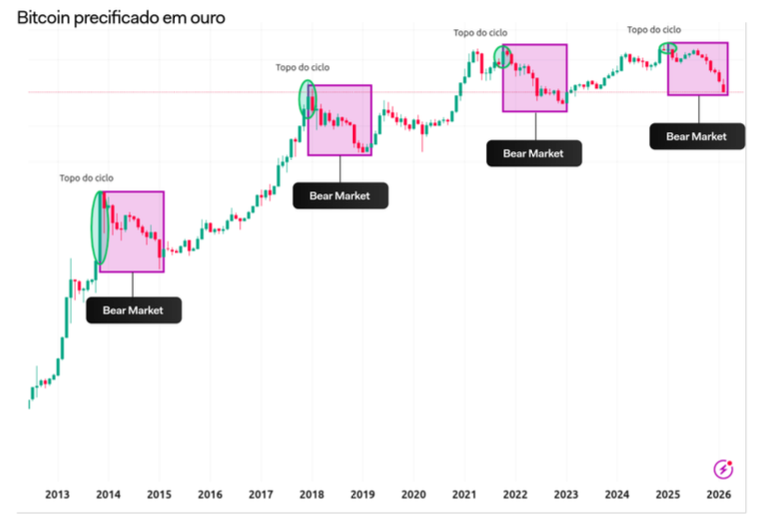
This divergence reflects broader macro forces.
Since the new administration of President Donald Trump took office, markets have faced aggressive trade tariffs, institutional conflicts within the United States, and rising tensions with China and Iran. Escalating tensions with the latter have led to continued military conflicts.
As a result, global uncertainty, as measured by the Global Uncertainty Index, has increased explosively. Gold has benefited from this shift, rising more than 80% to $5,280 over the past year. As capital turned into bullion, Bitcoin depreciated against bullion faster than against the dollar, Mercado Bitcoin analysts wrote.
Exchange-traded funds (ETFs) are also under increasing pressure. Since November, about $7.8 billion has been out of Spot Bitcoin ETFs, or about 12% of the total $61.6 billion.
But this fear-based selling only tells part of the picture.
While reactive capital is fleeing Bitcoin, large investors or “whales” are treating the downturn as an accumulation zone, the report adds, noting that Abu Dhabi’s leading investment firms Mubadala Investment Company and Al Warda Investments added spot Bitcoin ETF exposure in mid-February.
Against this backdrop, Szuster urges investors to structure their positions wisely and utilize dollar-cost averaging to take advantage of the current market uncertainty and avoid timing issues.
“Historically, purchasing during times of fear has been more effective than purchasing during periods of euphoria,” he writes. “Does this mean we’re already at the bottom? No. But statistically, it does mean we’re in the zone where the highest average prices usually form.”