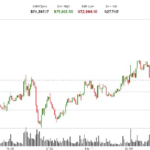


A numerical comparison between Bitcoin and gold highlights the large gap that still separates the two assets in terms of market size.
Specifically, based solely on current price and fixed supply, this exercise shows that even if Bitcoin’s value rises rapidly, it will never become equivalent to gold. Importantly, this calculation does not rely on forecasts or assumptions, but only on existing market data.
Important points:
- Bitcoin is trading at nearly $88,185 per coin, giving it a market capitalization of about $1.85 trillion.
- The maximum supply of Bitcoin is limited to 21 million coins.
- If Bitcoin’s price increases tenfold, its market value would reach approximately $18.5 trillion.
- The total market value of gold is estimated at $38.8 trillion at $5,570 per ounce.
- Even if the price rose tenfold, Bitcoin’s market size would remain less than half that of gold.
Bitcoin’s current valuation and hypothetical scenario
Bitcoin is currently trading around $88,185, down 2.1% over the past week. Maximum supply is limited to 21 million coins, and Bitcoin’s current market capitalization is estimated at approximately $1.85 trillion.
Starting from these numbers, a 10x increase in the price of Bitcoin would increase Bitcoin to approximately $881,850 per coin. Using the same fixed supply, the total market value of Bitcoin would be approximately $18.5 trillion. Note that these numbers are derived by simple multiplication and do not reflect predicted probabilities.
Putting numbers into the context of gold market size
Juxtaposing these calculations with gold gives a clearer sense of scale. Gold is trading at around $5,570, close to its all-time high of $5,602. At this price, the estimated value of physical gold in circulation around the world is approximately $38.8 trillion.
When you look at these figures together, you can see a clear difference. Even if Bitcoin were to rise 10x from current levels, its market capitalization would still be less than half of the estimated market value of gold.
Contrasting interpretations by market observers
Although this comparison itself is strictly mathematical, it has emerged with renewed debate about how Bitcoin and gold perform during times of economic stress.
Economist and market commentator Peter Schiff recently reiterated his position that rising gold and silver prices reflect growing concerns about financial stability.
According to Schiff, these price movements are not a sign of strength in cryptocurrencies, but rather that investors are bracing for more severe stress. Furthermore, he argued that rising US debt and a weaker currency tend to benefit digital assets, especially precious metals rather than Bitcoin.
Schiff also compared the current situation to 2007, when early red flags appeared before the global financial crisis. In his view, Bitcoin would not serve as a safe haven in a similar scenario, a position he has consistently maintained.
Structural changes in Bitcoin market trends
Meanwhile, other industry statistics focus on changes within Bitcoin’s own market structure, rather than comparisons to gold. Binance co-founder Qiao Changpeng suggested that Bitcoin may be breaking out of a long-standing cycle of four years of strong spikes followed by deep declines.
According to Zhao, 2026 could mark the beginning of a long economic expansion. He links this possibility to a more crypto-friendly policy environment in the US and similar regulatory changes in other countries.
This view is echoed by Nick Ruck, director of LVRG Research, who observed that traditional halving-driven cycles will begin to lose importance in 2025. He attributed this change primarily to the continued participation of institutional investors.
Institutional outlook reflecting evolving assumptions
Major financial companies are also adjusting their forecasts in response to changes in market conditions. Grayscale predicted in December that Bitcoin could reach an all-time high in the first half of 2026. The company cited macroeconomic demand, continued concerns about currency depreciation, and a more supportive regulatory backdrop in the United States.
Similarly, Standard Chartered has revised its framework. Jeffrey Kendrick, the bank’s global head of digital asset research, said the four-year cycle theory no longer captures current dynamics. The bank currently predicts that Bitcoin will reach $150,000 by the end of 2026.
Taken together, these perspectives show how interpretations can differ even though the underlying comparisons remain the same. Ultimately, given current prices and supply constraints, this calculation highlights a large gap between Bitcoin and gold in overall market size.