


Since the advent of ChatGPT and chatbots, the hype around artificial intelligence (AI) has evolved into “payments on behalf” being touted as the next wave of internet commerce without humans transacting.
AI agents will make payments to each other. The idea is simple. Build automated payment rails using AI agents that traditional companies like credit card companies struggle with.
And with crypto CEOs like Brian Armstrong and CZ touting AI agents, and McKinsey saying AI agents could mediate $3 trillion to $5 trillion of global consumer commerce by 2030, the conversation around agent payments is only increasing.
This is where x402 comes into play, an agent payments protocol supported by a consortium including Coinbase. This idea is ambitious. Embed stablecoin payments directly into the communication layer of the internet, allowing software to automatically charge other software.
Supporters of x402 believe the protocol has the potential to enable a new kind of Internet business built around small-scale automated payments. Traditional payment rails, such as credit card networks, are designed for human commerce, not payments of less than a few thousand cents between software services.
“It’s going to be difficult for existing payment processors to bring these merchants on board, not because they lack the technology, but because when a processor says yes to a merchant, they’re assuming that merchant’s risk,” said Noah Levin, a partner at a16z Crypto.
To take Levine’s scenario as an example, an AI agent tasked by a human to complete research might call a specialized API tens of thousands of times. Each request may cost less than a cent.
Over the course of a week, these calls can generate $40 in revenue for the developer running the service. Credit card companies are struggling because they can’t process these small payments or authenticate merchants.
“Processors will reject applicants that they can’t take on, and it’s very difficult to take on a tool that doesn’t have a website, no substance, and no track record,” Levine added.
Additionally, processing fees alone can exceed these small payments, and payment processors typically require intermediary and transaction history before approving a merchant account.
X402 could potentially solve this problem with agent payments via stablecoins.
The name x402 itself hints at the project’s ambition. This refers to HTTP 402 (“Payment Required”). This is a status code that was reserved in the early days of the Internet for a future when payments were built directly into web requests. That vision was never realized on the traditional web, but x402 proponents believe crypto rails may finally make it possible.
However, the problem is that this technology is still in its infancy and has not yet transitioned to on-chain use.
“Mostly a mirage”
According to Artemis’ on-chain analysis, approximately half of observed x402 transactions reflect human activity, calling them “gamed” activity rather than genuine commercial transactions.
“The x402 ‘payments on behalf’ boom remains largely a mirage,” Artemis analysts wrote about X in February.
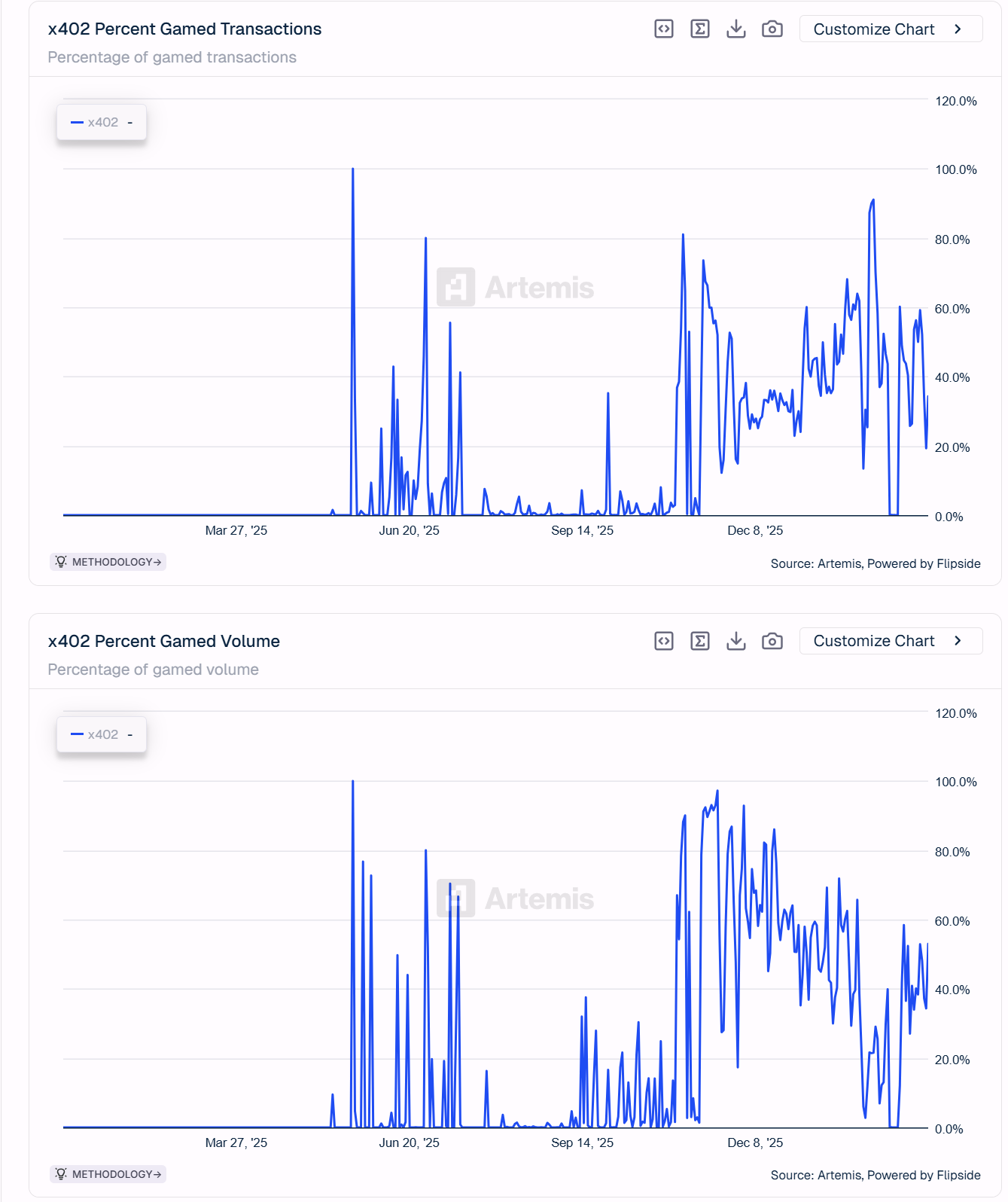
A recent daily snapshot shows approximately 131,000 transactions yielding a transaction value of approximately $28,000, with an average payout amounting to approximately $0.20.
The network has recorded sharper spikes in activity, including one day in February when it recorded 3.8 million transactions and approximately $2 million in trading volume. But on-chain analysts at Artemis say much of the surge is due to infrastructure testing and experimental use.
Artemis categorizes these “gaming” transactions into two buckets. One is self-dealing, where the same wallet acts as both buyer and seller, and the other is wash trading, where the seller funds the buyer’s wallet and the buyer sends the money immediately after the transaction.
In other words, much of the traffic that runs through protocols today does not yet resemble commerce.
However, these types of transactions are expected during the early stages of network testing. “These percentages should naturally decrease as teams move from testing to production and start serving real users,” Artemis said.
“Open standards like x402 are designed to be permissionless and open, meaning no single entity will manage all interactions, just as no one ‘controls’ all computers using HTTP. Naturally, this means that people sometimes experiment with the system in unintended ways,” Eric Lepel, head of engineering for the Coinbase developer platform and founder of x402, told CoinDesk.
A $7 billion ecosystem?
This gap between real and “gamed” transactions can make the ecosystem seem overwhelming at first glance.
And if you look at the overall ecosystem market cap (the total value of all tokens and projects built within the network; not to be confused with the network’s token market cap, as there is no token for x402), which is currently around $7 billion, it looks out of sync with the daily payouts of around $28,000.
Given this gap, some may be ready to dismiss this paper as wishful thinking like crypto games of the past with huge valuations and small numbers of users.
However, the CoinGecko category also includes the Chainlink category, so it should not be taken at face value. $LINK A token with a market capitalization of $6.3 billion. $LINK is not a pure play x402 asset.
Chainlink supports the protocol through integrations such as the Chainlink runtime environment. $LINK It predates x402 and plays a much broader role across other crypto infrastructures. Inclusion in this category artificially inflates the category and sets expectations too high for such new protocols.
Is it still early?
While coordinating significant contributions from $LINK While the token market cap and ecosystem may move closer to trading reality, core challenges remain. That said, sellers that x402 is designed to offer services are still rare.
The x402 protocol is not trying to replace cards or traditional payment systems. Instead, it targets a new category of digital commerce: small-scale automated services used by AI agents and software systems.
As AI tools make it easier to build and launch software, more and more developers are creating small, single-purpose services, such as data feeds, image processors, and code testing tools, designed to be consumed by other software rather than humans.
It takes time.
“It’s essentially a micropayment rail,” Artemis analysts said. “Its true utility comes at small transaction sizes, powering things like pay-as-you-go APIs, content generation, and agent throttling.
But for now, at this stage of this new agency commerce, these sellers remain rare.
Previous attempts at similar ideas in cryptocurrencies have struggled to gain traction. Micropayment systems, browser monetization models, and more associated with the Lightning Network bat$0.09734 ecosystem, and various decentralized computing marketplaces all promised a new Internet economy but often failed to attract sustained real-world use.
The narrative around agent commerce is growing faster than the use that justifies it. The difference between the size of the protocol’s ecosystem and the roughly $28,000 per day in payments indicates that while the infrastructure for proxy payments is first arriving, the economics it must support may take longer to develop.
But the vision behind x402 – an internet where AI agents seamlessly pay each other through stablecoins – remains appealing. “While we probably overestimate the rate of agent commerce adoption next year, we significantly underestimate how much it will be within five years,” Artemis analysts said.
“When agent commerce arrives, you either adopt the standard or you get left behind.”