
The first week of the U.S.-Iranian war has already cost taxpayers more than $11 billion, roughly half of the government’s total Bitcoin holdings, according to figures provided privately to Congress.
To put this into context, as of March 13, the U.S. government held 328,372 Bitcoins, worth approximately $23.13 billion. This shows that fighting has already used up about half of that total, or 48.9%.
At this rate, Bitcoin’s entire reserves, worth about $1.88 billion each day, would be depleted in just over 12 days.
Officials were quick to point out that the $11.3 billion figure would not fully cover the cost of the war. Lawmakers are seeking more information about the war, and the White House is expected to ask Congress for additional funding soon, according to several congressional sources.
Some officials put the estimate at $50 billion, but others say that may not be enough.
The government’s Bitcoin stockpile, built from seized assets and established by executive order, is intended to be kept indefinitely and not sold, even in times of conflict.
Democratic lawmakers are demanding that administration officials testify publicly about the potential duration of the conflict and what would happen to Iran if the fighting ends.
A joint airstrike between the United States and Israel on February 28 marked the beginning of the conflict. Since then, fighting has spread to Lebanon. The Strait of Hormuz was effectively closed due to Iranian military retaliation. Oil prices soared as a result of the shutdown, with Brent crude at one point reaching $119.50 per barrel.
See also Interpol efforts reduce cryptojacking in Southeast Asia by 78%
according to jake Ostrovsky “Oil movements are more important to cryptocurrencies than geopolitics itself,” said Wintermute’s head of OTC trading.
“If Brent prices continue to rise above $80 for more than a few sessions, the story of re-inflation is It hardens. ”
Cryptocurrency is as stable as the stock market struggle
Despite the turmoil in global markets, cryptocurrencies have held up better than stocks and bonds this month. Bitcoin has risen nearly 8% since the first U.S. attack on Iran in late February, even as stock markets struggle under the weight of high oil prices. The digital currency appears to have found a floor around $72,000.
Analysts say one reason for the relative strength of cryptocurrencies is that people in the Middle East are worried about losing access to banks.
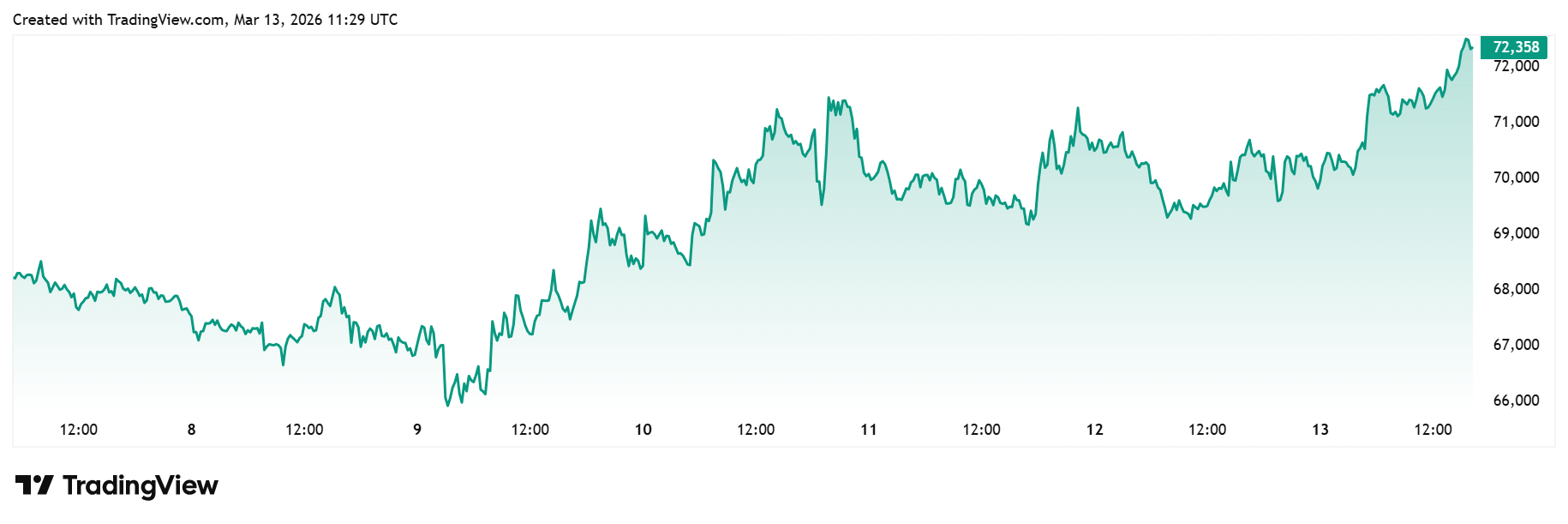
Bitcoin is stable at around $72,000 as of March 13, 2026. Source: Trading View
Stephen Coltman, head of macro at 21Shares, explained that residents of cities like Dubai and Abu Dhabi, suddenly faced with the possibility of regional wars, are looking for safe places to park their funds at a moment’s notice.
Stock exchanges in both cities were temporarily shut down at the start of the conflict, but Bitcoin continued to trade around the clock.
“If you’re someone who is in Dubai or Abu Dhabi and suddenly has to leave immediately because you’re worried about losing access to the banking system, Bitcoin may seem like an attractive place to put your assets,” Coltman said.
See also AirAsia’s cargo chain announces network powered by blockchain technology
Analysts say war spending could drive Bitcoin higher say
In the long run, some analysts believe that war spending itself could increase Bitcoin.
According to Arthur Hayes, co-founder of BitMEX and chief investment officer at Maelstrom, excessive military spending would force the Federal Reserve to lower interest rates and inject money into the financial system to finance the war.
When interest rates fall, investors tend to take riskier bets, and Bitcoin has historically benefited from such situations. Hayes said this trend has often occurred in past U.S. military conflicts.
London Crypto Club analysts David Brickell and Chris Mills say Bitcoin will win no matter which way the war goes. If the conflict drags on, frightened investors will be forced to turn to Bitcoin as a safe haven. They argue that a quick end to the fighting would restore confidence and trigger a wave of buying.
James Butterfill, head of research at CoinShares, added that assets like Bitcoin, which are rare and not controlled by any government, could benefit in the medium term if confidence in the global financial system continues to decline.