

While attention has shifted away from non-fungible tokens (NFTs), Bitcoin-based NFT With revenue approaching the $6 billion threshold, the network quietly claims third place among blockchains in total NFT I increased my sales and got over the Ronin era. At the same time, Ordinal’s inscription on the Bitcoin blockchain has surpassed the 100 million milestone.
Bitcoin NFT Sales of nearly $6 billion
Exactly three years ago, on December 14, 2022, Bitcoin developer Casey Rodalmore introduced the Ordinals Protocol, and two days later the first Ordinal Inscription (1) was minted on the Bitcoin blockchain. In the first few months of 2023, interest in Ordinal’s inscription rapidly accelerated, gaining traction across the cryptocurrency ecosystem.
Simply put, Bitcoin Ordinal engraving uses the Taproot transaction’s Witness field to place arbitrary data, such as images or text, directly into the smallest unit of Bitcoin, an individual satoshi. Sequence theory assigns each Satoshi a unique serial number based on the mining order, allowing the data to be appended on-chain without changing Bitcoin’s protocol, giving rise to so-called digital artifacts.
Arbitrary data can take many forms, including plain text, images, code, and applications. By September 2024, the chain reached 75 million registrations, and then in the first week of November 2025, it crossed the 100 million mark. At the time of writing, ordinarys.com shows over 117 million registrations as of the second week of January 2026. Statistics for ord.io and ordinarys.com.
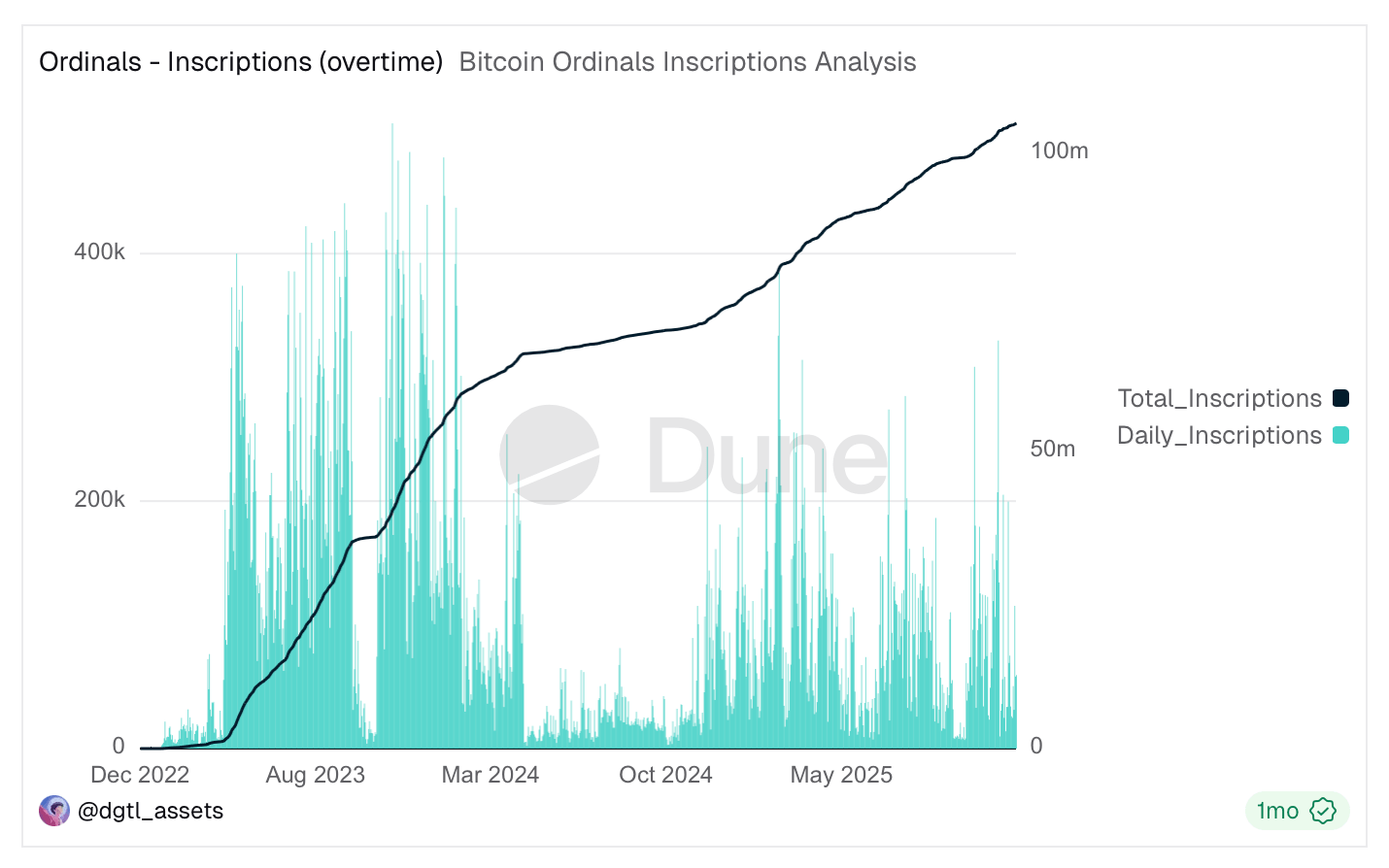
Dune statistics from user @dgtl_assets shows a difference of more than 10% between the numbers from ordinarys.com and ord.io.
An analysis of Dune.com’s data shows that Bitcoin miners collected approximately $646 million in registration fees, with an estimated 10.3% undercount in mind. The majority of these fees, measured in 7,092 Bitcoins collected from Inscription, occurred around and in the period leading up to Bitcoin’s fourth halving. Since then, miners have received relatively less revenue from subscribers than in the early days.
From a sales perspective, Bitcoin has surpassed several blockchains that moved large amounts of NFTs long before that. NFT The craze of 2020-2021 has reached its peak. According to data from cryptoslam.io, Bitcoin currently ranks third with total revenue of $5.8 billion. Only Ethereum and Solana rank higher, and Bitcoin would need approximately $688 billion more in sales to overtake Solana (assuming Solana’s numbers remain the same, of course).
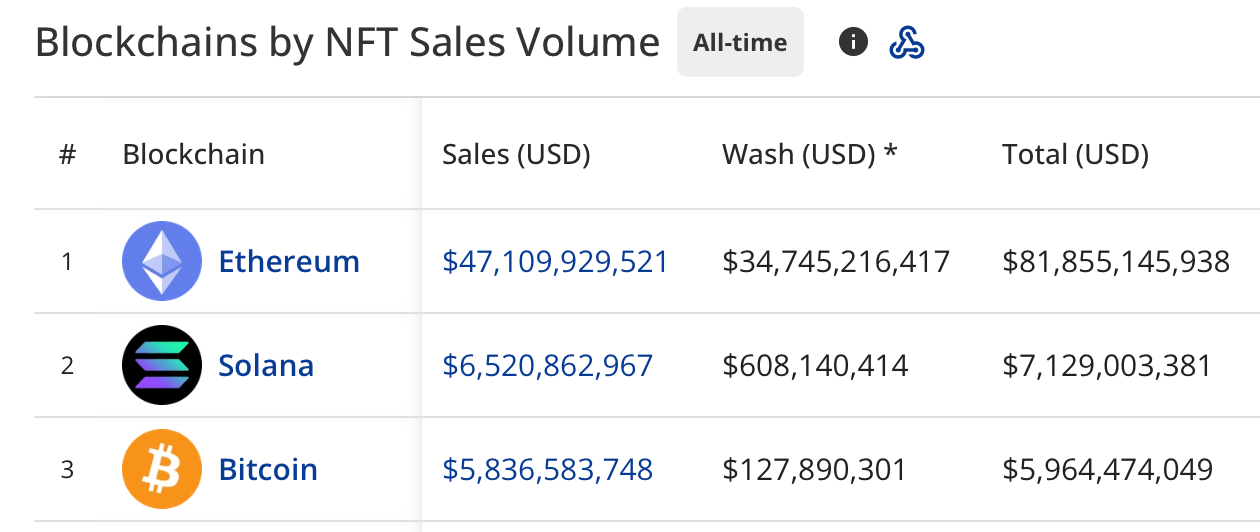
NFT cryptoslam.io sales data for January 15, 2026.
Bitcoin comfortably surpassed Ronin, the network behind the Axie Infinity NFT, which hit $4.3 billion. NFT sale. This number also exceeds Polygon’s $2.2 billion in digital collection sales and Flow’s $1.73 billion total. According to cryptoslam.io statistics for the past 7 days, Bitcoin ranks third in terms of revenue with $6.9 million, and on a monthly basis it moves to second place with $62 million, an increase of 88% month-on-month.
Still, it’s hard to ignore how NFTs are becoming less prominent in the broader cryptocurrency conversation. Outside of niche circles, digital collectibles are no longer an everyday topic, and the retail attention that once drove the 2020-2021 boom has largely moved elsewhere. Against this background, Bitcoin NFT The numbers are more like a quiet accounting milestone than a cultural renaissance. It’s proof that activity continues, even as the hype fades and attention shifts to other parts of the market.
Also read: Ripple locks RLUSD into LMAX’s $8.2 trillion trading engine
This contrast may be the most important point. Bitcoin’s rise to the upper tier NFT Sales have been driven by ordinary users and a steady, if narrow, user base, without any fanfare, celebrity drops, or retail frenzy. Whether that foundation proves durable or remains a historical footnote will depend less on sales figures and more on whether NFTs regain relevance beyond professional communities or remain a modest sideshow while Bitcoin continues to dominate the cryptocurrency narrative for entirely different reasons.
Frequently asked questions ❓
- What makes Bitcoin tick? NFT How has it grown in recent years?
Bitcoin’s NFT This activity is facilitated by Ordinal Inscription, which embeds data directly into Satoshi without changing Bitcoin’s core protocol. - How much of total sales did Bitcoin NFTs generate?
Bitcoin NFTs have recorded cumulative sales of approximately $5.8 billion, ranking third on the network after Ethereum and Solana. - How many Ordinal inscriptions are there in Bitcoin currently?
The Bitcoin blockchain hosts over 117 million Ordinal inscriptions as of mid-January 2026. - Are Bitcoin NFTs still profitable for miners?
Registration fees generated significant revenue around the halving in the fourth quarter, but contributions have since declined significantly compared to previous peaks.