



Ethereum (ETH) is gaining significant attention from institutional investors and consumers alike, with on-chain data showing increased engagement across staking, fund accumulation, and wallet creation.
Related Reading: New Addresses on Ethereum Hit Record Levels What is driving growth?
Similarly, price outlooks remain mixed. Major banks and market analysts see room for further upside, but others warn that macro conditions, ETF flows and technical resistance levels could limit near-term upside.
With ETH trading in the $3,300-$3,400 range in mid-January, the network’s fundamentals appear to be more solid than in previous quarters. However, whether these developments will lead to sustained price increases remains an open question.
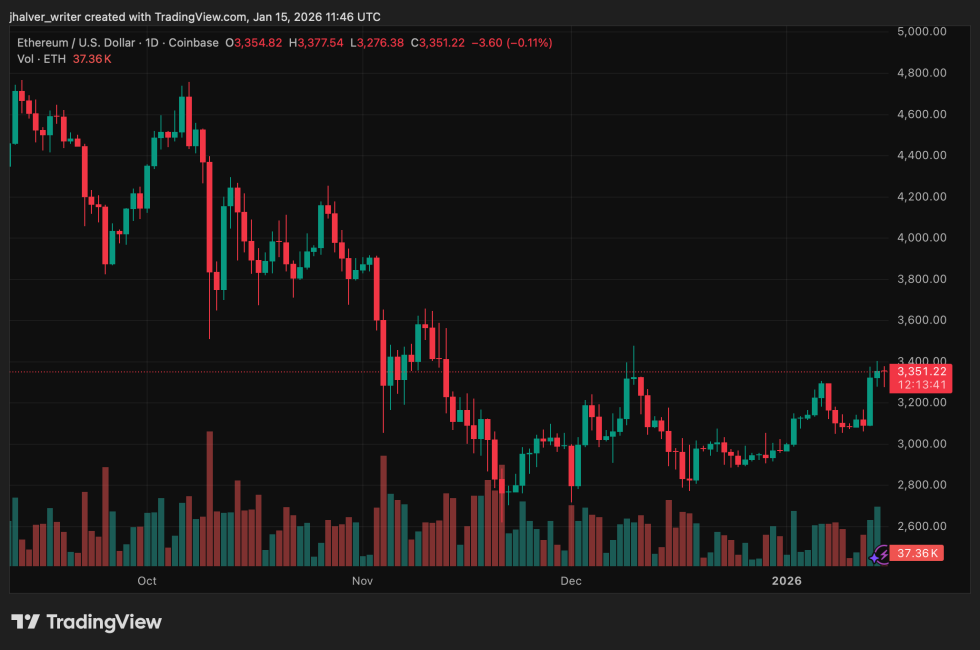
ETH's price trends upwards on the daily chart. Source: ETHUSD on Tradingview
Ethereum staking and Treasury demand represent long-term commitments.
Ethereum staking has reached a record value of approximately $118 billion, with approximately 35.8 million ETH locked in the beacon chain. This represents almost 30% of the circulating supply, suggesting a preference among holders for taking profits rather than selling.
Network participation is also increasing. The number of active validators currently exceeds 976,000, with approximately 2.3 million ETH waiting for future staking. Lido Finance remains the largest staking provider, holding about a quarter of all ETH staked.
Corporate finance activities have added to this trend. BitMine Immersion, one of the largest Ethereum treasury companies, recently staked an additional 154,304 ETH, worth approximately $514 million at current prices. The company’s total ETH holdings currently exceed 4 million.
Agency forecasts point to higher goals
Several financial institutions have revised their 2026 Ethereum forecasts. Standard Chartered recently raised its year-end ETH price target to $7,500 from its previous estimate of $4,000. The bank cited expectations for increased demand from corporate treasuries, spot ETH investment products, and increased network fees.
According to analysts, flows related to government bond companies and ETFs have absorbed about 4% of Ethereum’s circulating supply since mid-2025. Treasury buyers alone reportedly acquired about 2.3 million ETH in about two months, a good pace compared to the bank’s past Bitcoin accumulation phases.
Standard Chartered also suggested that Ethereum could surpass Bitcoin if real-world usage, stablecoin activity and tokenized asset adoption continue to expand on the network. Under the long-term scenario, costs could reach up to $25,000 by 2028 and $40,000 by 2030. However, these predictions rely on optimistic assumptions.
User growth increases, but ETH price faces technical limits
Ethereum’s user base is also expanding. In early January, the network recorded nearly 393,600 new wallet addresses per day, with a weekly average of over 327,000 new addresses.
Analysts link this surge to the Fusaka protocol upgrade, which reduced data costs on Layer 2 networks and led to stablecoin transfers reaching nearly $8 trillion in late 2025.
Related reading: Call for boycott of draft CLARITY bill: Experts raise concerns about bank manipulation
Despite stronger fundamentals, price action remains cautious. ETH recently tested the $3,400 resistance level, with major hurdles near $3,550 and $3,650 based on its long-term moving average. Support is forming around $3,000, and if this level is not maintained, ETH could fall further.
Cover image by ChatGPT, ETHUSD chart by Tradingview
editing process for focuses on providing thoroughly researched, accurate, and unbiased content. We adhere to strict sourcing standards, and each page is diligently reviewed by our team of top technology experts and seasoned editors. This process ensures the integrity, relevance, and value of the content for readers.