Ethereum has recorded a new level of on-chain activity, with daily transactions and active addresses on the L1 network hitting record highs. Meanwhile, gas prices have fallen to their lowest levels in years.
According to Token Terminal data, daily transactions on Ethereum exceed 2 million, and active addresses have remained above 1 million in recent weeks. These record activity levels coincided with low gas prices, averaging nearly $10 million to $20 million per day, compared to the highs of more than $200 million per day recorded during the 2021 bull market.
Ethereum gas prices fall to record lows
A recent surge in institutional investment and retail adoption has increased Ethereum’s network usage. The token saw over 50 million transactions in August alone, the highest number for the month.
According to DeFiLlama, during the same period, decentralized exchange (DEX) trading volume also reached an all-time high of more than $130 billion. data. Network transaction value reached $320 billion, making it the third busiest month in Ethereum trading activity.
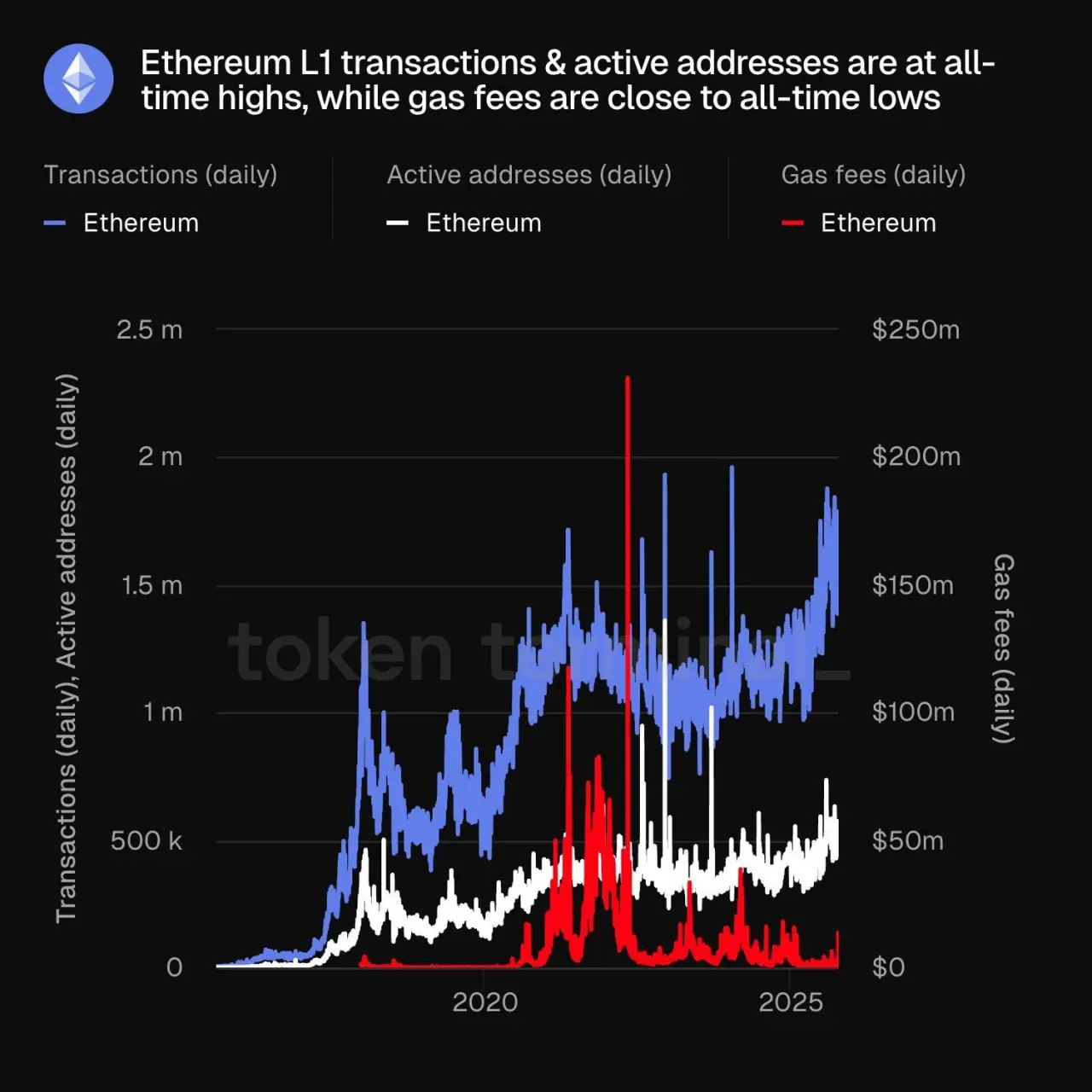
Current market activity level for Ethereum. Source: Token Terminal
Meanwhile, Ethereum’s Total Value Lock (TVL) has risen to around $86.04 billion, approaching the historic high of $108.8 billion set in 2021. The increase in on-chain liquidity and activity reflects trust in the ecosystem and widespread use of layer 2 scalability networks such as Arbitrum, Optimism, and Base.
Croptopolitan reported that Ether trading volume expanded in August, indicating strong on-chain activity. This result coincided with further expectations for ETH to reach a new all-time high and cross the $5,000 hurdle for the first time.
Ethereum activity has returned to levels not seen since 2021, indicating a combination of value growth and on-chain transfers. The recent ETH rally also showed that L1 is sufficient for large-scale DeFi, without any significant gas spikes or congestion.
The increase in activity is seen as a sign that the retail industry is returning. Over the past few quarters, retail trade has largely abandoned ETH, but whales continued to accumulate. Currently, Ethereum activity shows a shift in sentiment, with users returning to their most active apps. The Ethereum network uses USDT and USDC to perform simple ETH transfers based on gas usage. top 3 smart contract.
Overall, Ethereum is smart contract Creation expanded in 2025, returning to the level of activity seen in 2021. This time, smart contracts were tied to DeFi rather than NFT or meme token launches.
Although on-chain volume activity remains high, Ethereum’s average gas price is currently at its lowest annual average price in the network’s history. This decrease is primarily due to the adoption of layer 2 rollups and protocol level improvements such as EIP-4844 (Proto-Danksharding), which significantly improve data availability and reduce mainnet congestion.
Improved scalability of the Ethereum network accelerates organizational adoption
Daily active addresses on Ethereum recently exceeded 650,000, marking the highest level in the past two years. Historically, such fee reduction periods have been associated with a surge in retail activity as small investors and users re-engage with DeFi protocols, gaming platforms, and NFT marketplaces.
Lower gas prices have increased trading volumes in DeFi and NFT projects in the range of 15% to 20%. This indicates that small, price-sensitive users, who have previously been price-limited during times of network congestion, may return.
data from strategic ether reserve indicates that BitMine is the primary institution holding Ethereum tokens under its reserve strategy. BitMine’s current holdings are 3.03 million ETH, making it the largest corporate holder of Ether.
Another institutional investor, SharpLink, recently added 39,000 ETH to its holdings, bringing its total to 838.73,000 ETH. These accumulation trends suggest that large enterprises increasingly view Ethereum as a utility network and long-term store of digital value.
According to CoinMarketCap data, The current price of Ether token is $3,974.41, which corresponds to a decline of 2.77% at the time of publication. The token market capitalization also decreased to $479.99 billion, with an average 24-hour volume of $57.56 billion, representing a 1.15% decrease at the time of issuance.