


Ethereum price is holding firm on the important massive support around $1,800, but the fading bullish participation is increasing the risk of a deeper correction move and possible capitulation to the downside.
summary
- Control point at $1,800 weakens, increasing downside vulnerability
- Sideways price movements lack bullish volume and suggest distribution risk
- Loss of support can cause surrender, heading into areas of lower value
Ethereum ($ETH) The price trend is approaching a pivotal moment as it continues to trade around the key support zone defined by the Point of Control (POC) near $1,800. This level represents the most heavily traded area within the current range and is acting as temporary support after the recent decline. However, despite holding this zone for several sessions, Ethereum failed to generate a convincing bullish continuation in the daily time frame.
As the consolidation continues and volume weakens, there are growing concerns that this pause may not mean accumulation, but diversification before another drop. If Ethereum fails to defend this massive support on a closing basis, the likelihood of a capitulation style move increases.
Important technical points of Ethereum price
- Control points near $1,800 are under pressureserves as the last large scale support
- Daily consolidation shows weak follow-throughindicating weak demand
- Losing support opens the downside towards the low of the value area.in line with the Fibonacci extension target
You may also like: Crypto regulation in Asia: Hong Kong to issue stablecoin license as Malaysia tests ringgit digital asset
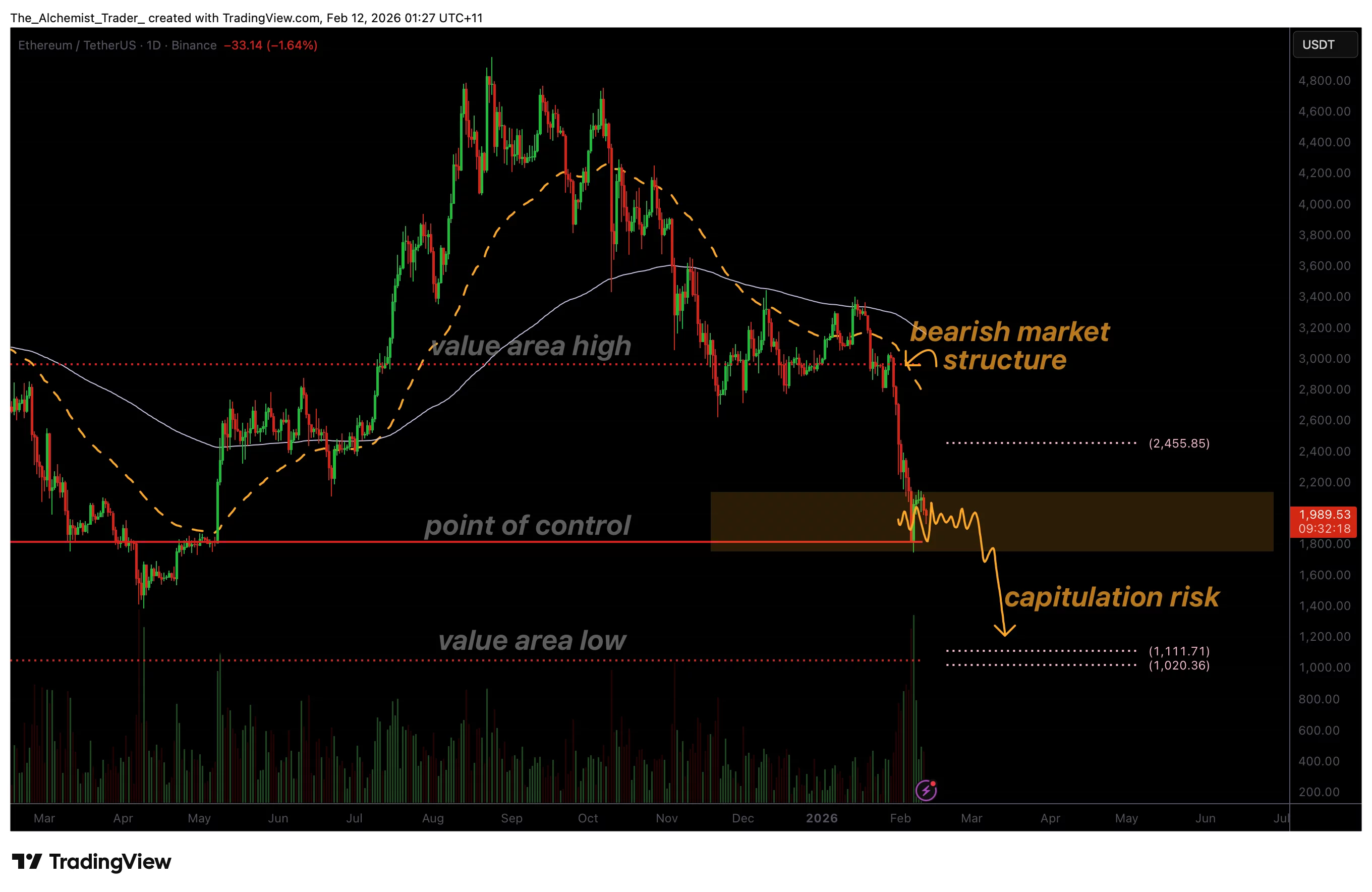
ETHUSDT (1D) chart, source: TradingView
Ethereum’s current move around $1,800 is technically significant. Although the price has not broken out yet, the lack of upward follow-through after the initial pullback is a warning sign. In a strong reversal, consolidation at support is usually accompanied by an expansion in bullish volume and an increase in daily closing prices. Instead, Ethereum has spent multiple sessions sideways, suggesting buyers are struggling to regain control.
This type of price movement is often preceded by a continuation movement rather than a reversal. If there is no new demand and the market consolidates into larger nodes, it becomes more likely that support will eventually be lost as sellers absorb the remaining bids.
Volume profile highlights lack of bullish commitment
From a volume profile perspective, Ethereum’s current bounce is unconvincing. Bullish volume has steadily declined since price first reacted from the $1,800 area, indicating that buying interest is not strong enough to sustain a meaningful recovery. An imbalance between price stability and declining volume often indicates exhaustion rather than strength.
As a result, the current structure resembles a pause within a broader corrective trend rather than the basis for a reversal. Without clear volume expansion, Ethereum remains vulnerable to renewed selling pressure.
You may also like: Goldman Sachs warns of inflation risks that could derail Fed rate cut plan
Yield risk increases below control point
Control points often act as stabilizing forces during the integration phase. However, when the price loses POC on a daily closing price basis, it typically signals a transition from balance to imbalance. In the case of Ethereum, such a move could trigger an accelerated decline as the price searches for the next major area of acceptance.
Below the current range, the next major target is located at the low of the value area, which coincides with the 1.618 Fibonacci extension of the current downside price movement. This zone represents a typical capitulation target, where emotional selling and liquidity sweeps often occur before the market attempts to form a durable bottom.
A move into this region does not necessarily imply continued long-term weakness. Rather, it represents the final stage of the current correction cycle, potentially clearing out weak positioning and resetting the market structure.
What to expect from future price trends
From a technical, price volatility, and market structure perspective, Ethereum is at a make-or-break level. If the consolidation continues without a bullish extension, the chances of an eventual failure of the $1,800 support increase. If the daily closing price is confirmed to be below the reference point, the risk of capitulation towards the lower range will increase significantly.
For the bearish scenario to be invalidated, Ethereum would need to regain higher value levels with strong volume and demonstrate sustained acceptance above current resistance. Until that happens, downside risk remains high.
read more: Beyond HODLing: Maximize your Ripple portfolio with CLS Mining’s stable return model for XRP and RLUSD