



Ethereum broke through a key demand level and fell to the $2,660 range, its lowest point in months. The decline signals a clear loss of bullish control as fear spreads through the markets. Traders who once expected a strong recovery are now reassessing their positions, and sentiment across social and on-chain indicators has taken a sharp turn toward panic. But even in this capitulation-driven environment, early signs of potential resilience are beginning to emerge.
According to Lookonchain, one of the most notable Ethereum whales, “66kETHBorrow,” has aggressively doubled down on his strategy. First, he accumulated 57,725 ETH worth $162.77 million, which caught the attention of analysts during the biggest sell-off. Just a few hours later, he added 7,837 ETH ($21.9 million) to his position, demonstrating his firm conviction despite market turmoil.
This aggressive accumulation stands in stark contrast to the widespread fear gripping Ethereum holders. Strategic buyers appear to be stepping in while retail traders are giving in and leveraged positions are being pushed out. To many analysts, this type of behavior has historically suggested a premature formation of a regional bottom.
Whale Accumulation Signals Confidence Amid Ethereum’s Bearish Market
According to the latest data from Lookonchain, the whale known as “66kETHBorrow” has currently amassed a whopping 440,558 ETH worth about $1.23 billion. This makes him one of the largest individual Ethereum holders who actively accumulated during the current recession, and the size of his positions is sending a strong signal to the market.

While the price of Ethereum continues to struggle below key support levels, the behavior of these whales stands in sharp contrast to the fear-driven selloff that is dominating retail traders. Instead of reducing his exposure, he is adding aggressively, even though the ETH charts are showing a steady downtrend and sentiment is extremely bearish. Historically, this type of money accumulation during panic phases often coincides with the initial stages of a trend reversal or the formation of a local bottom.
The reason is simple. This is because large companies typically operate based on long-term certainty rather than short-term volatility. Their willingness to increase exposure at a time when most investors are succumbing is often interpreted as a strong vote of confidence in Ethereum’s fundamentals and future valuation.
ETH falls below key level
Ethereum broke through a key support level and slipped into the $2,660 area in a decisive sign of market weakness. The chart shows a clear downward trend that has formed over the past few weeks, with ETH continuously printing lower highs and lower lows as selling pressure accelerates. The 50-day moving average and the 100-day moving average crossed below the 200-day moving average, forming a downward trend, indicating prolonged downward momentum.
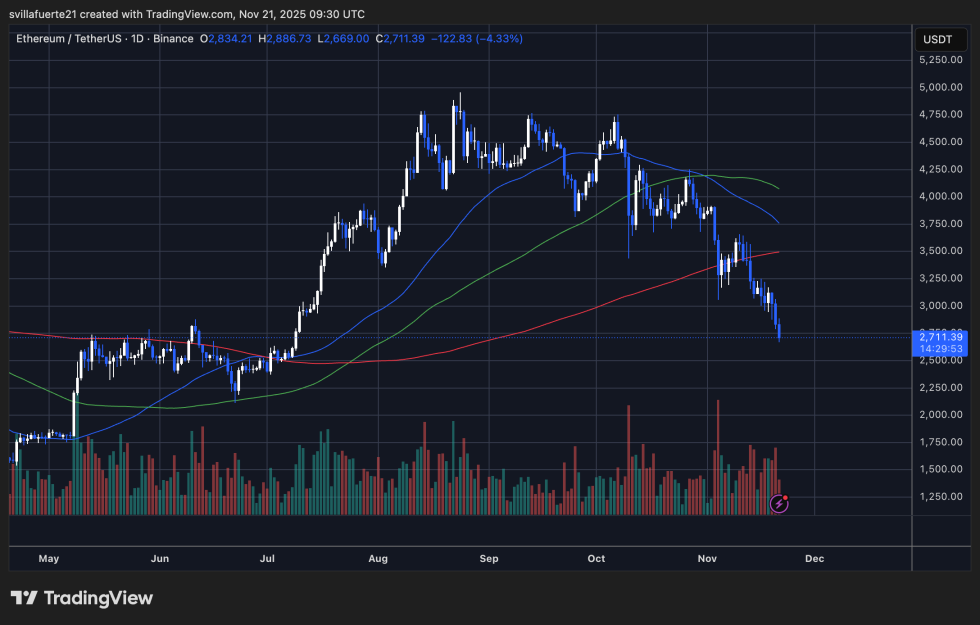
The surge in volume during the selloff highlights increasing liquidation pressure, confirming that the decline is being driven by aggressive sellers rather than passive drift. Ethereum attempted a small bounce throughout November, but each bounce was rejected by lower resistance levels, showing a clear lack of bullish confidence.
The price is currently struggling to maintain the $2,700 area, an important psychological level that served as support during the previous correction.
However, a positive sign is that there is notable buying interest from larger players. Despite the bearish structure, the volume pattern shows intermittent build-up from deeper declines, suggesting an early attempt to form a local bottom. Nonetheless, ETH remains vulnerable unless it regains its 50-day moving average and stabilizes above $3,000.
Featured image from ChatGPT, chart from TradingView.com
editing process for focuses on providing thoroughly researched, accurate, and unbiased content. We adhere to strict sourcing standards and each page undergoes diligent review by our team of top technology experts and seasoned editors. This process ensures the integrity, relevance, and value of the content for readers.