
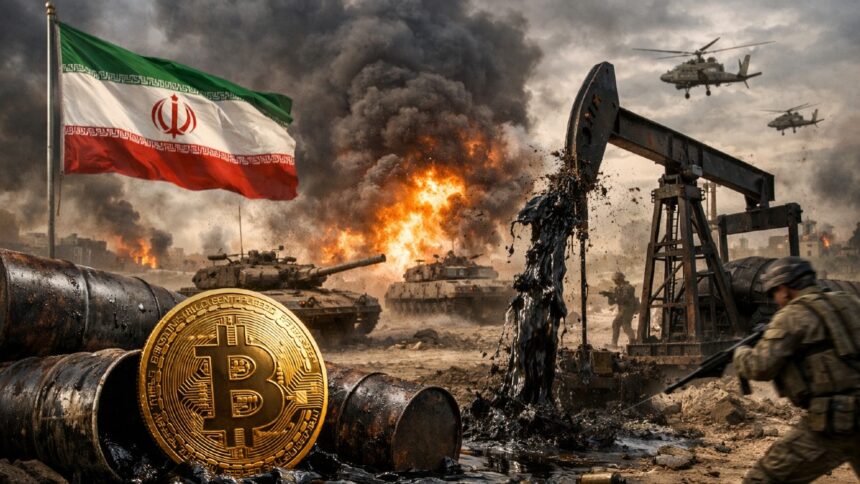
This Thursday, Brent crude oil prices reached $119 per barrel, a figure not recorded since March 7, 2022. The price hike, driven by war tensions between the US, Israel and Iran, means that the price has increased 8% from its original $110 in the past 24 hours.
This rebound in Brent crude – the standard for almost 70% of the crude oil traded around the world – May lead to inflationary pressures that directly affect monetary policy of the United States Federal Reserve System (FED).
In the following graph you can see the price of Brent from 2022.
The relevance of this increase lies in the following facts: Brent is the world’s main energy indicator. It is estimated that 65% to 70% of the crude oil traded internationally.especially at sea, sets prices in relation to this asset.
Brent oil is a petroleum extracted primarily from the North Sea (between the UK and Norway), which by its nature is cheaper to process into gasoline or diesel, making it a preferred resource for refineries and an important driver of the real economy.
Strait of Hormuz blockade
The current crisis is based on the blockade of key routes after more than two weeks of hostilities. The conflict led to the closure of the Strait of Hormuz. Transporting 20% of the world’s oil and large amounts of liquefied natural gas (LNG).
Add to this scenario the explosions of refineries and terminals in Iran, Qatar, Iraq and the United Arab Emirates, and countries such as Saudi Arabia and Kuwait are forced to cut back on extraction as resources cannot be distributed.
The Federal Reserve Dilemma
Increased energy costs Bringing multiplier effects to the real economy, raising transportation costs and industrial production.
As reported by CriptoNoticias, US Federal Reserve President Jerome Powell addressed the issue yesterday after the Federal Open Market Committee (FOMC) decided to maintain the federal funds rate at 3.75% year-on-year on March 18, 2026.
Chairman Powell warned that “higher energy prices will likely push up headline inflation in the short term.” The official said it was “too early to know the extent and duration of the potential economic impact,” but vowed that “we will not cut interest rates unless the economy shows clear signs of progress in the fight against inflation.”
This position suggests that The cost of money will continue to rise and investment in assets considered “risky” will be discouraged.like Bitcoin.
Bitcoin faces high interest rate scenario
Considering the possibility that US interest rates will remain high to contain the cost of living, Bitcoin (BTC) price reacted lower and lost the $70,000 support.
Bitcoin price reflects the severity of macroeconomic expectations. After starting the week on Monday, March 16th at $75,884; Bitcoin plummets below $70,000 On the day.
Historically, in the absence of interest rate cuts in the United States, asset prices tend to stagnate as high credit prices drive investors away from volatile assets.
Despite the bearish trend, uncertainty regarding Bitcoin as a hedging asset persists. If the Strait of Hormuz crisis continues and the Brent River continues to riseThe market needs to decide whether Bitcoin will function as a traditional risk asset or whether there is a programmed scarcity It protects the dollar from the decline in purchasing power caused by inflation.