

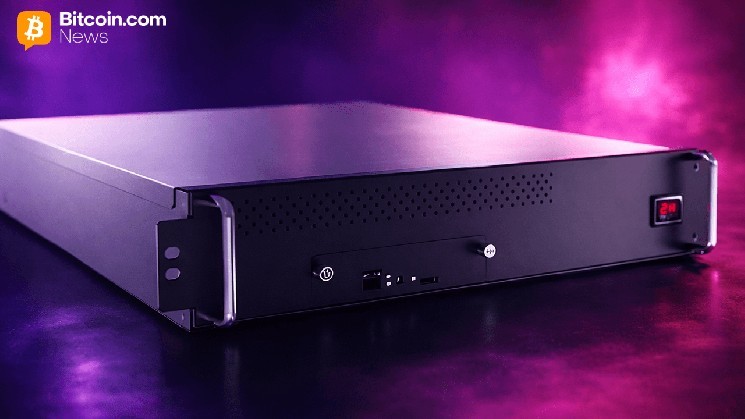
MicroBT has rolled out two new water-cooled Bitcoin mining rigs aimed squarely at industrial operators, combining higher hash rates with tighter efficiency as competition for block rewards intensifies.
Expanding ASIC lineup with MicroBT
The company continues its commitment to large-scale liquid-cooled mining infrastructure with the introduction of Whatsminer M6DS+ and M6DS++ in March 2026 as part of the broader M7D series expansion. Both machines rely on water cooling systems rather than traditional air cooling, allowing operators to perform higher density deployments while maintaining stable temperatures under sustained workloads.
The Whatsminer M6DS+ offers a baseline hash rate of approximately 504 terahash per second (TH/s), but some configurations can be higher depending on overclocking tuning and operating conditions. Its energy efficiency is rated at around 17 joules per terahash (J/TH), and power consumption is close to 8,568 watts, but can reach around 9,200 watts in some setups.
The upper tier Whatsminer M6DS++ increases up to approximately 556 TH/s, with ranges beyond that reported in certain configurations. Efficiency increases to approximately 15.5 J/TH, but power consumption approaches 8,618 watts and can rise further depending on deployment parameters.
Both models build on MicroBT’s earlier M70 series, released in late 2025, and reflect the continued transition to water-cooled systems that can maintain high power output without the thermal constraints of air-cooled units. In reality, these machines are designed for mining farm and institutional operators rather than hobbyists, taking into account power requirements and infrastructure needs.
However, profitability is closely related to external variables, not just hardware specifications. Based on the situation in mid-March 2026 (Bitcoin trading price around $74,000 to $76,000, network difficulty close to 145 trillion, hash price around $32 per petahash per day), this number is conservative.
M6DS+ is estimated to generate approximately $16.14 in revenue per day, which equates to approximately $2.60 to $3 in net profit at an electricity rate of $0.06 per kilowatt hour (kWh). On the other hand, M6DS++ generates approximately $17.81 per day in revenue, with estimated net revenues ranging from $4.10 to $5.51 under similar power costs.
These margins may not seem dramatic, but they highlight the growing disparity in the mining economy, where only the most efficient machines survive as difficulty increases. Older, less efficient rigs are increasingly being eliminated, especially in regions where power costs exceed industry benchmarks.
MicroBT’s latest release recognizes that reality and prioritizes efficiency gains and thermal management over incremental upgrades. For large operators, the message is clear. Scale and efficiency remain key, and water cooling systems are quickly becoming the norm rather than the exception.