


Peter Brandt, a veteran commodity trader, Posted This is a devastating bearish warning for Bitcoin, the top cryptocurrency by market capitalization.
According to Brandt, cryptocurrencies could face the double whammy of short-term technological capitulation to the $58,000-$62,000 range and long-term existential risks posed by technological obsolescence.
Back to $58,000?
Mr. Brandt’s downside price target suggests a severe market correction of nearly 40%. “I think $58,000 to $62,000 is where it’s going to go,” Brandt said.
Chart shared by blunt This indicates that the correction from recent highs is not yet over. This indicates a possible bearish continuation with a firm focus on the $60,000 region.
It has a large flared top (megaphone pattern) marked by points 1 to 5. This pattern is characterized by higher highs and lower lows.
This pattern resolved to the downside at point B, and the price decisively lost support of the lower trendline.
Following the collapse, Bitcoin made a rescue rally to point P (approximately $102,233). This move served as a classic “bearish retest.”
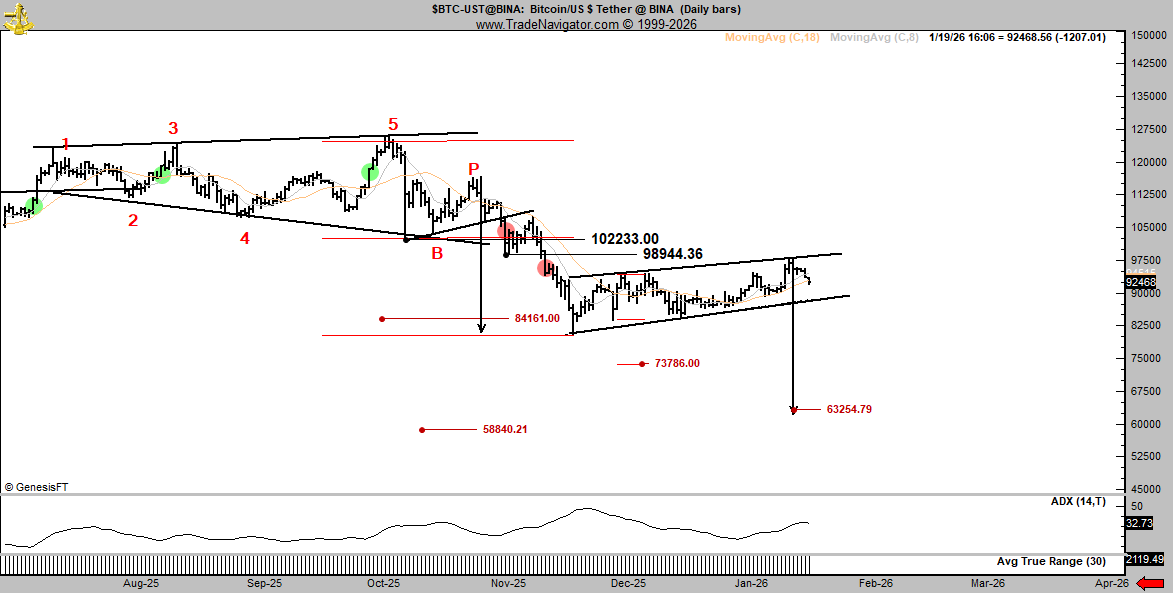
Because it was rejected at point P, Bitcoin It is trading within a narrow upward parallel channel.
Bitcoin is currently testing the lower bound of this flag near $92,468. A breakdown from this channel will confirm the decline on the next bar.
The current flag breakdown is targeted at $73,786. This could be followed by further expansion to $63,254.
The final downside price target shown on the chart is $58,840.
“If I can’t do it, I won’t be ashamed…I’m wrong 50% of the time. I don’t care if I’m wrong,” he wrote.
“Quantum” threat
blunt He took aim at the narrative that “Bitcoin will rise forever” and argued that Bitcoin has a “serious flaw” because it assumes technological stagnation.
“It has a predisposition that nothing better than this will be developed/invented. That is certainly a dangerous assumption as we approach quantum computing,” Brandt argued.
The “quantum threat” has long been a tail risk lurking in the background of crypto discussions, and Brandt doesn’t think it should be ignored.