

Paraguay seeks use of seized miners for state-run Bitcoin operation
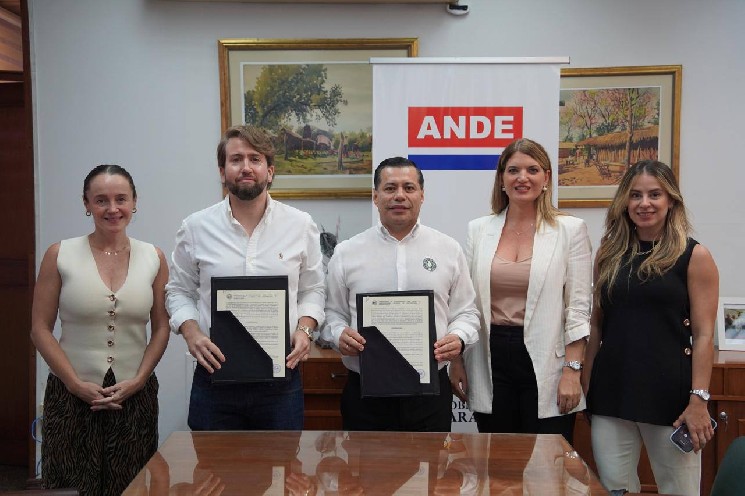
Paraguay’s state-owned electricity monopoly, the National Electricity Administration (ANDE), has signed a Memorandum of Understanding (MOU) with Morphware, setting the stage for a government-led Bitcoin mining program built around thousands of seized mining machines and unused hydropower.
The agreement formalizes the cooperation between ANDE and Morphware, positioning Morphware as a technical and advisory partner for regulated Bitcoin mining operations in Paraguay.
At the heart of the deal is a growing stockpile of confiscated Bitcoin miners that Paraguayan authorities have seized from illegal operations across the country.
Kenso Trabing, founder and CEO of Morphware, said the government has “approximately 30,000” Bitcoin miners who have been exploited by businesses accused of stealing power or falsely registering as other types of businesses to get cheaper electricity rates.
“They’re literally stacked to the ceiling,” Traving said. bitcoin magazinedescribes a government warehouse full of unused machinery.
Paraguay has become a destination for Bitcoin miners in recent years due to its abundance of low-cost hydropower, much of which is generated at the Itaipu dam and exported to Brazil.
However, the rapid influx of miners has also led to rampant power abuse, with many operators illegally tapping into the grid or misclassifying their activities to avoid industrial tariffs.
These practices encouraged enforcement and resulted in large-scale foreclosures. Although the government succeeded in removing these miners from the power grid, tens of thousands of machines remained behind and there was no clear plan for how to use them.
Morphware’s proposal, now reflected in an MOU, would relocate the seized miners to utility-controlled sites near electrical substations. Under the agreement, ANDE will retain ownership and oversight, while Morphware will provide training, operational guidance and technical expertise.
“They have no experience mining Bitcoin,” Trapping said. “Our role is an advisory one.”
The company will assist ANDE in converting existing utility facilities into basic mining facilities. Many of these structures are already installed next to electrical substations and can be modified by removing walls, installing ventilation, and adding transformers, distribution units, and instrumentation. The goal is to turn stranded and underutilized power into a new source of revenue for the state’s utility companies.
Electricity in Paraguay is highly political, with different tariff systems for households, priority industries, and mature sectors. $BTC Although mining falls into the higher rate category, illegal operators often try to avoid these costs.
By carrying out mining operations directly through ANDE-managed infrastructure, governments can increase compliance while reaping benefits for themselves.
“This is about a regulated, utility-controlled site,” Trapping said. “These are not people hiding in the countryside.”
Just in:
Paraguay’s National Electricity Authority signed a memorandum of understanding to “explore the role of Bitcoin mining as a national opportunity.”
They plan to use Bitcoin miners to turn unused electricity into “a new source of revenue for Paraguay.”
pic.twitter.com/LwEWmUrJW5
— Bitcoin Magazine (@BitcoinMagazine) March 3, 2026
What happens to Bitcoins mined in Paraguay?
A key issue under discussion is how to handle the Bitcoin produced by Paraguay. Trapping said there are active discussions within the agency. Some officials support selling Bitcoin immediately to fund public programs such as social security, education, and infrastructure.
Some have floated the idea of holding Bitcoin or managing price risk through financial markets.
Morphware recommends a conservative approach with a focus on derivatives. Trapping said the company has discussed a sale. $BTC Utilize futures trading on US exchanges as a means to hedge production and stabilize profits.
The company also warns against allowing government agencies to directly store Bitcoin. Paraguay has suffered major cybersecurity breaches in recent years, including a ransomware incident that infiltrated systems across multiple ministries.
Although the agreement focuses on Bitcoin mining, it also reflects a broader shift in Paraguay’s view of electricity exports. The country consumes only a small portion of the electricity it generates and sells the rest overseas at relatively low rates.
Mining provides a way to monetize surplus energy domestically without waiting for traditional industrial demand to emerge.
“When you do the math, it’s very simple,” Trabing said. “You’re selling power for a fraction of the revenue you would make if you used it locally.”
This MOU marks the first formal step in that direction. Trapping said the initial phase will focus on deploying the seized miners and training ANDE staff on mining operations, grid integration, and basic Bitcoin concepts.
Over time, he believes this model has the potential to expand. If the experiment is successful, Paraguay could finance new mining equipment using structured financial products tied to future Bitcoin production, rather than relying solely on seized hardware.
“This is the future of midstream power,” Trapping said. “The grid not only provides electricity, but also owns a stake in the digital infrastructure it enables.”
The post Paraguay’s Exploration to Use Seized Miners in State Bitcoin Operation first appeared on Bitcoin Magazine and is written by Micah Zimmerman.