

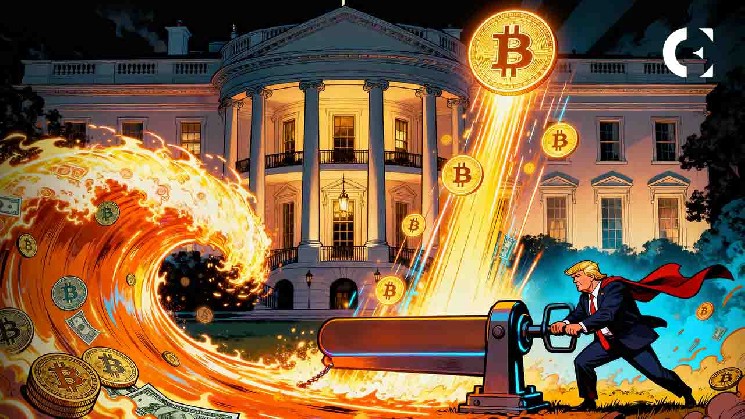
President Donald Trump has outlined a timeline for his proposed $2,000 “tariff dividend,” telling reporters that his administration expects payments to begin reaching eligible Americans around mid-2026 or once Congress approves the plan.
The White House wants to redirect fee revenue to “middle-class” and “middle-income” households, but the proposal still lacks clear legal authority and faces budget constraints. For the market, the combination is a source of further uncertainty as Bitcoin and other digital assets lose ground.
Related: President Trump’s tariffs caused $19 billion in crypto liquidations in 24 hours
White House sets goals for 2026 as legislative and budget gaps persist
Trump’s remarks, reported from the Oval Office, expanded on earlier suggestions that tariff revenue could be directed to working families. He presented the $2,000 figure as part of an effort to ease household budget pressure while managing the federal debt. The new detail is timing. The administration has tied the plan to mid-2026, raising expectations that a decision is coming soon, with political and market attention focused on whether the proposal can actually pass Congress.
Treasury Secretary Scott Bessent has made it clear that the government cannot make any payments without legislation. In an interview with Fox News, he said teams “need a law” to distribute dividends, noting that the final design could use tax rebates or credits instead of paper checks. He also stressed that any benefits would be targeted at “working families” rather than high-income earners, as income limits would apply.
connection:Will Donald Trump’s tariff policies affect sentiment in the global crypto market?
Budget groups say the numbers are not yet consistent with politics. The Committee for a Responsible Federal Budget estimates that $2,000 payments to adults and children could cost as much as $600 billion. The tariffs had raised about $195 billion through Sept. 30, according to federal data, far short of the amount needed for widespread payments.
Supreme Court tariff case could shrink funding pool
The plan also depends on whether the tariff revenue survives a Supreme Court case that could overhaul limits on the president’s trade powers. The ongoing lawsuit considers whether President Trump exceeded his authority when he used his national emergency powers to impose broad tariffs on a wide range of imports. During oral arguments, both conservative and liberal justices expressed doubts about some aspects of the policy, raising the possibility that the court would narrow or reject the approach.
If the court rules against the administration, the federal government could be required to return some of the money it collects from importers. That would reduce or eliminate the pool that Trump wants to turn into $2,000 dividends. Mr. Bessent said he did not expect such an outcome, but acknowledged that an unfavorable ruling could pose “significant issues” including the possibility of large repayments.
Economists also point out that tariffs are actually taxes imposed not only on foreign exporters but also on domestic buyers. Higher levies can increase input costs and retail prices, reducing trading volumes. Future dividends will recycle funds extracted from consumers and businesses through the tariff system and will not distribute a new pool of external funds.
New 500% Tariff Tool Adds Pressure to Crypto Market
Separate from the dividend proposal, a new bill backed by Republicans adds another layer of sharpness to the trade debate. The measure would impose tariffs of up to 500% on countries that continue to import Russian products and energy.
Sen. Lindsey Graham said the goal was to cut off financial channels supporting Russia’s war effort and encourage allies to cooperate more with U.S. sanctions.
JUST IN: 🇺🇸🇷🇺 President Trump approves bill authorizing 500% tariffs on countries trading with Russia. pic.twitter.com/qaBKVUMwTN
— BRICS News (@BRICSinfo) November 17, 2025
The headlines come as risk assets are already under pressure. The announcement triggered a new wave of volatility across the cryptocurrency market, which had been gaining traction in recent weeks. Approximately $620 million in positions were liquidated in 24 hours as prices broke through key levels, affecting more than 152,000 traders.
While Bitcoin fell toward $90,000, large altcoins such as XRP, Solana, and Cardano also posted significant losses during the day, reflecting how quickly macro shocks can trigger forced selling in crowded trades.
Disclaimer: The information contained in this article is for informational and educational purposes only. This article does not constitute financial advice or advice of any kind. Coin Edition is not responsible for any losses incurred as a result of the use of the content, products, or services mentioned. We encourage our readers to do their due diligence before taking any action related to our company.