


David Duong, head of global investment research at Coinbase, expressed deep concerns about the long-term security and sustainability of Bitcoin due to advances in quantum computing.
Bitcoin is often characterized by its high level of security, primarily due to its underlying blockchain technology. However, experts warn that new threats using quantum computing could pose significant risks to cryptography-based cryptography (CRQC).
Quantum computing threatens Bitcoin’s cryptographic security
David Duong, Head of Global Investment Research at Coinbase, said: warned Advances in quantum computing are raising concerns about Bitcoin’s long-term sustainability. Coinbase executives cited previous concerns highlighted by BlackRock in its amended prospectus for the iShares Bitcoin Trust ETF (IBIT) filed with the SEC on May 9, 2025.
black rock highlighted It said in its filing that advances in quantum computing technology could render the cryptographic infrastructure supporting Bitcoin “defective or ineffective.” The investment fund explained that quantum computing is still in its early stages of development, making it difficult to predict its ultimate impact on broader blockchain infrastructure.
The report also noted that quantum computing applications could advance to the point where they would have the ability to compromise Bitcoin’s security by allowing malicious attackers to penetrate Bitcoin’s security and compromise Bitcoin-held wallets.
According to Duong, quantum computing will require upgrading many of the cryptographic systems currently in use. He also explained that traditional finance may be one of the most affected sectors as it relies too much on closed systems. Duong said open protocols such as Bitcoin and Ethereum are also preparing for the impact of quantum computing.
Duong said a cryptographically relevant quantum computer (CRQC) could gain the ability to execute Scholl’s or Glover’s algorithms, which could destabilize Bitcoin’s cryptographic infrastructure. He highlighted that this new technology has two types of risks in its sights: it could compromise Bitcoin’s SHA-256, which is used for the proof-of-work mining process, and the Elliptic Curve Digital Signature Algorithm (ECDSA), which powers transaction signatures.
Coinbase researchers said quantum computers related to cryptography could break the “cryptographic security of private keys” and allow malicious attackers to steal crypto assets from vulnerable addresses. He added that by mining blocks more efficiently, other attacks could penetrate Bitcoin’s mining infrastructure.
32.7% of BTC supply is at risk of long-range attacks
Duong added that while quantum mining is a low-priority concern for now, signature migration does come with immediate risks. He said the initial threats are “split into two aspects: long-range attacks on the output, where the public key is already published on-chain, and short-range attacks, where the public key appears in the memory pool, potentially pre-empting spending.”
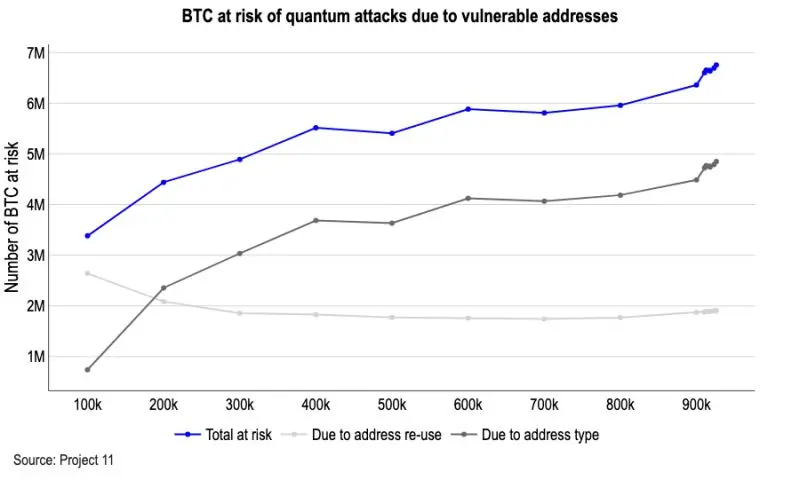
Source: David Duong, CFA, Coinbase BTC at risk of quantum attacks due to weak addresses
According to researchers, about 32.7% of Bitcoin’s supply, or about 6.51 million BTC, is vulnerable to long-range attacks due to the reuse of addresses and script types that reveal on-chain public keys. He highlighted scripts such as Pay-to-Public-Key (P2PK), bare multisig (P2MS), and Taproot (P2TR).
He also said that all outputs are vulnerable to short-range attacks at the time of expenditure, so there is a need to move to quantum-resistant signatures, even though the probability of attack is low.
The warning comes as scientists continue to advance the development of quantum computers. Quantum computers use quantum mechanics to process data in a more sophisticated way than traditional computers.
Pierre-Luc Dallaire Demers, a quantum computing scientist at Google, said in October 2025 that these advanced computers could crack Bitcoin within five years.
Although quantum computing is still in its infancy, a recent report from Cryptopolitan noticed Google claimed breakthrough advances in AI and quantum computing. The technology conglomerate announced that it has developed a computer algorithm that points to a potential path toward commercialization of quantum computing. According to the report, Google said the algorithm generates unique data for use in AI.