
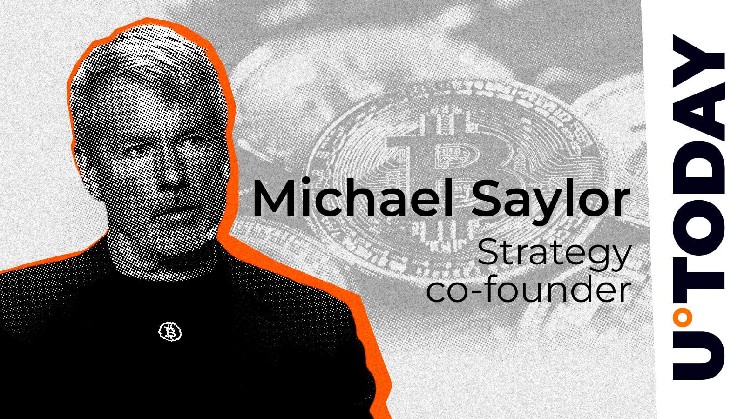
Michael Saylor, Executive Chairman of MicroStrategy, said: not selling Bitcoin (BTC).
When asked if there is a price point at which MicroStrategy would be forced to capitulate and sell its holdings, Saylor completely rejected that premise.
“That’s unfounded. The truth is, our net leverage ratio is half that of a typical investment-grade company,” Saylor said. “We have 50 years’ worth of dividends in Bitcoin. We have two and a half years’ worth of dividends in cash alone on our balance sheet. So we’re not going to sell, we’re going to buy Bitcoin. I think we’ll be buying Bitcoin every quarter forever.”
Characterized by volatility
MicroStrategy’s stock price has fallen significantly over the past year. But Saylor doesn’t seem fazed by the decline. He explained that the company is designed to act as a leverage vehicle for Bitcoin exposure. He argued that investors need to adjust their time horizons to understand asset classes.
“The company is designed to amplify Bitcoin,” Saylor explained. “So when Bitcoin goes up, it goes up faster. When Bitcoin goes down, there’s more volatility. We created 80x more assets.”
Regarding the underlying asset itself, Thaler argued that price fluctuations are a necessary component of its performance.
“I think the key thing to keep in mind is that Bitcoin is digital capital. Bitcoin will be two to four times more volatile than traditional capital like gold, stocks, real estate, etc.,” he said. “It’s outperformed traditional capital by a factor of two to four over the past decade. It’s the most useful global capital asset in the world.”
liquidation myth
Asked what would happen if Bitcoin suffered a catastrophic, multi-year collapse, Saylor argued that the company has plenty of room to react without selling its stack.
“If Bitcoin falls 90% over the next four years, we will refinance the debt,” Saylor said. “Look, we’re at 68,000 right now. We literally have to get it down to 8,000. Then we just refinance the debt. If we think it’s going to go to zero, we’ll deal with it. But I don’t think it’s going to go to zero. And I don’t think it’s going to get to 8,000 either. But the credit risk is minimal at this point.”
He also clarified the company’s cash position relative to debt.
“We have two and a half years of cash dividend coverage and debt coverage. We’ve raised $4 billion so far this year. Last year we raised $25 billion. The company has no credit risk.”