


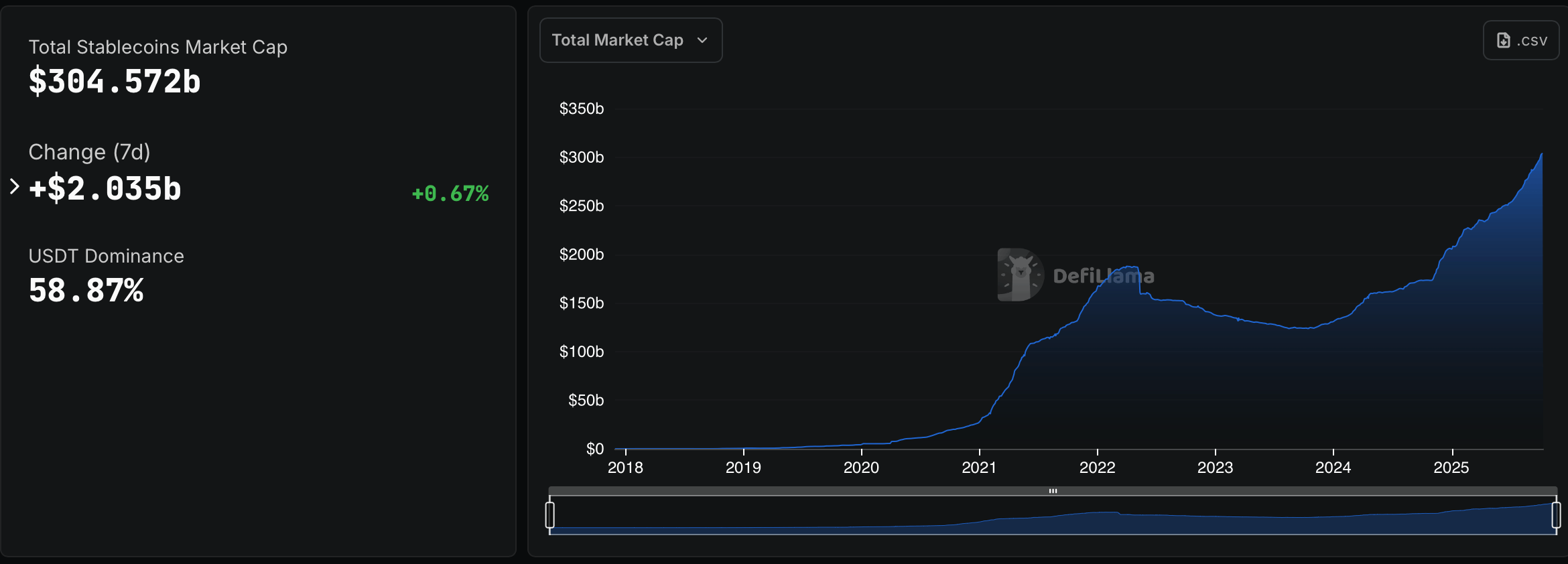
According to data from Defillama, the global stablecoin market added $2.035 billion in just 7 days, bringing the total capitalization to $304.57 billion. This represents an increase of 0.67% over the week. But the breakneck growth behind these numbers goes even further.
The quiet rise of stablecoins: the $304 billion digital backbone
Once a niche experiment for crypto traders looking to escape volatility, stablecoins have evolved into one of the most important instruments of digital finance. These now act as digital stand-ins for traditional currencies, which are typically pegged 1:1 to the US dollar, allowing users to hold and transfer value without the price fluctuations of Bitcoin or Ethereum.
Basically, a stablecoin is a type of cryptocurrency that is designed to maintain a stable value compared to fiat currency, most often the US dollar. It aims to be fixed at $1, rather than fluctuating wildly like most digital assets. Issuers achieve this stability by backing each token with assets such as cash, US Treasury bills, and other reserves. In short, stablecoins can provide calm in the often turbulent waters of cryptocurrencies.
Source: Defillama.com
People are drawn to stablecoins for simple reasons: speed, cost, and reliability. Trades typically settle in seconds, fees are often a fraction of a cent, and holders can escape the volatility that plagues most cryptocurrencies. For many users outside the United States, stablecoins offer stability and access to global markets that local currencies cannot always guarantee.
Overview of the current stablecoin cycle
According to stablecoin statistics from defillam.com, Tether (USDT) remains the dominant player in the industry, accounting for 58.87% of the total stablecoin market with a capitalization of approximately $179.3 billion. Circle’s USDC followed with $74.77 billion, while Ethena’s USDe moved into third place with $14.29 billion. Together, these three stablecoins account for over 85% of the sector’s total value.
Below the top trio, Dai (DAI), SkyDollar (USDS), and BlackRock’s BUIDL round out the next tier, with their respective market caps hovering between $2.6 billion and $5 billion. Paypal’s PYUSD, which was introduced just last year, has quietly surpassed $2.5 billion. This is a sign that corporate-issued stablecoins are gaining momentum.
Meanwhile, fiat-pegged crypto token issuers such as Falcon Finance’s USDf, First Digital’s FDUSD, and Ripple’s RLUSD are carving out a niche role and collectively contributing to a more diverse and competitive stablecoin ecosystem.
10 years of growth
The stablecoin market has risen from less than $3 billion in 2018 to more than $300 billion in 2025, representing a staggering 100x expansion in just seven years. This growth reflects, and in many ways enabled, the broader development of decentralized finance (DeFi) and crypto-based payment systems.
Digital fiat tokens have become an essential layer of modern crypto infrastructure, as centralized exchanges, DeFi protocols, and fintech companies increasingly rely on stablecoins for liquidity and payments. This week’s $2 billion rally provides many traders with protection from the effects of this week’s crypto market and signals continued confidence in the sector.
If current trends continue, the stablecoin market could soon rival the GDP of a small country. The question is not whether they will continue to exist, but how deeply they will be integrated into everyday finance.
🧠Frequently Asked Questions
- What is the current stablecoin market capitalization?As of the seven-day period ending October 11, it was $304.57 billion.
- How much has it grown recently?The market has increased by $2.035 billion over the past week, an increase of 0.67%.
- Which stablecoin is the largest?Tether (USDT) leads with 58.87% market power among all stablecoins by value.
- How long have stablecoins been around?The first major stablecoins appeared around 2014, but explosive growth really began in 2020 due to the rise of DeFi and other macroeconomic changes.
- Why are stablecoins important?It bridges traditional finance (TradFi) and blockchain systems, providing cross-border liquidity, speed, and reliability.
- Are all stablecoins backed by dollars?Most are pegged to the US dollar and some are backed by other assets such as US Treasuries and algorithmic mechanisms. Others are based on alternative fiat currencies of various nation-states.
- What’s next for the stablecoin market?We expect increased integration into payment systems, continued institutional adoption, and continued regulatory formation.