

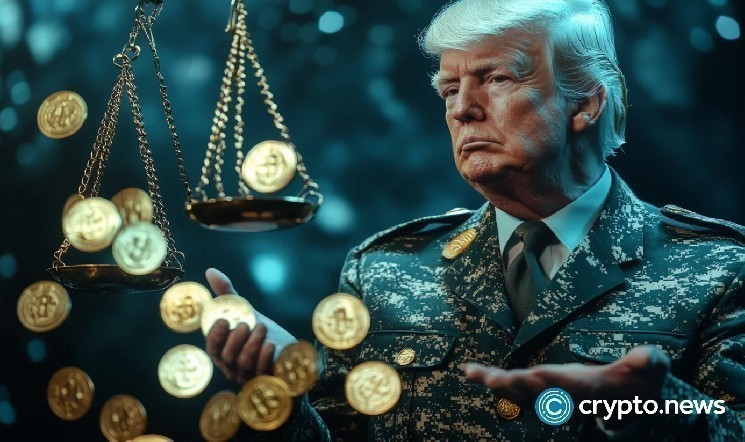
President Trump’s ‘America First’ crypto reserve plan inspires mobilization $BTC, $ETH, $XRP, $SOL and $ADA On the other hand, severe questions are being raised about digital assets that are politicized and controlled by the state.
summary
- President Trump outlined the U.S.’s “Strategic Cryptocurrency Reserve.” $XRP, $SOL, $ADA, $BTC and $ETHpitching it as a way to elevate the industry and restore U.S. leadership.
- $XRPSolana and Cardano experienced extraordinary price increases after their announcements. $BTC and $ETH It oscillated between rapid rises and rapid mean reversions.
- While supporters frame the reserves as a validation and geopolitical tool, critics warn that they could politicize cryptocurrencies, centralize wallet control and become partisan weapons.
Donald Trump’s surprising plan for America’s first cryptocurrency program achieved exactly what his campaign had hoped for. This means bringing digital assets back into the spotlight of politics and markets, while also forcing even the most ardent crypto believers to decide whether they actually trust the state as a long-term custodian of their money.
What President Trump announced
In March 2025, President Trump stated in his Executive Order on Digital Assets that he directed the Presidential Task Force to “advance the Cryptocurrency Strategic Reserve, which includes: $XRP, $SOLand $ADA” he added later. $BTC and $ETH…It will be the focal point of the reserve. He framed the reserve as a way to “uplift this vital industry after years of corrupt attacks by the Biden administration,” and vowed to “enable the United States to become the crypto capital of the world.”
In response, markets, as they always do with White House headlines, pushed the pledge to the fore. $XRP was up nearly 30% to around $2.80, and Solana was up about 20% to around $170. Cardano initially rose over 60%, then stabilized around $1.02, while broader market data showed an increase of around $170. $BTC +11%, $ETH +16%, $SOL +28%, $XRP +34%, and $ADA Immediately after that it was +81%.
Shortly after President Trump’s announcement last March, Bitcoin itself soared from about $86,000 to $94,000 before falling. In a market update, $BTC Shares fell 7.6% on the day to around $84,540 as post-announcement volatility began to reverse.
Smell verification by enthusiasts
For some in the crypto industry, this is finally a state acknowledgment of what they have been preaching for a decade. “America’s crypto reserves will strengthen this critical industry after years of corruption attacks,” President Trump wrote, a sentiment echoed by many. $XRPHolders of Solana and Cardano are already treated as de facto institutional validation. GSR’s Spencer Harran said the comments “resulted in participants rushing to rebuild their long positions, which is a nice tailwind for prices.”
Pro-Bitcoin voices also see it from a geopolitical perspective. Sen. Cynthia Lummis previously pushed for the Government-Owned All Bitcoin Act $BTC In his submission to the Treasury Department, he argued that becoming the first developed country to use Bitcoin as a “savings technology” would secure its position as a global leader in financial innovation. In this framework, these reserves sit alongside strategic oil reserves and gold holdings, making them monetary weapons rather than mere speculative punts.
Skeptics warn about politicized money
But the reaction to X has been more contradictory than the jump in initial prices suggests. One widely shared post captured the anxiety. “Strategic Cryptocurrency Reserve Meeting ($BTC, $ETH, $ADA, $SOL, $XRP) The hype died down for a short time. Some traders are feeling a little nervous. ” Strategist Ilan Solot warned on Binance Square that the altcoin pairing “may just be President Trump’s usual negotiating tactic.” $XRP, $SOL and $ADAso he can get one $BTC (and probably $ETH),” he wrote in a note pointedly titled “Curb Your Enthusiasm.”
Mainstream retailers are also putting on the brakes. CNBC reported that pro-Trump tech and crypto players are “outraged” by the idea of politicized reserves, warning that it could distort an asset class designed to be outside of government control. Hill raised five unanswered questions, including who actually controls the wallets, how reserves are valued on the federal balance sheet, and what would happen if a future administration decides to prioritize tariffs and capital controls over digital opening up.
Beyond the Sugar High
The U.S. already has about 200,000, according to a more recent breakdown. $BTCis the world’s largest government asset, and President Trump’s move could prompt other major economies to formally implement their own reserves, he said.
You may also like: Bithumb Recovers Almost All Bitcoin After Recent Airdrop Error
Bloomberg, Fortune and others noted that countries such as Switzerland, Brazil and Hong Kong are already discussing similar structures, and that U.S. reserves could stabilize liquidity and expand U.S. influence over global crypto regulation.
For now, traders are treating crypto reserves like any other policy-driven catalyst. In other words, it is a volatility event that is traded rather than a complete architecture that you can rely on. The real test is whether this reserve ends up as a transparent, rules-based backstop or a discretionary political plaything that makes the most decentralized market on the planet dependent on who is in the White House.
read more: US Federal Reserve issues new crypto program for local banks