
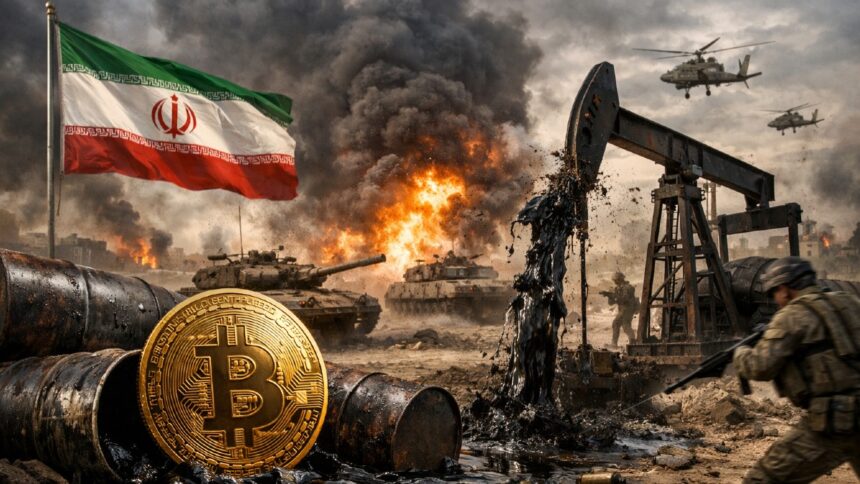
After the first 13 days of fighting in the Persian Gulf, Bitcoin (BTC) and raw materials markets are behaving differently. While oil prices are operating under a panic-and-correction scenario, Bitcoin’s resistance since the attack began suggests that investors are justifying their theory of economic independence.
Differences between narratives regarding the duration of the conflict are a major source of current uncertainty. Meanwhile, President Donald Trump’s administration insists this is a “short war” lasting four to six weeks.
“I think the war is effectively over. We’re very advanced. I don’t know, it depends. Shutting down Iran is on my mind, not anyone else’s,” the US president recently told CBS. They were almost completely neutralized.
But political analysts such as Qatar-based Middle East expert Luciano Zaccara warn that the duration is unpredictable. Zaqqara points out that Iran is bracing for at least six months of conflict and that the regime has already chosen a new supreme leader.
For analysts, Iran’s ability to launch daily drones into Gulf states poses logistical problems. There is a possibility that the airport will remain closed. In addition to rising global transportation costs, If the Strait of Hormuz is closed, it will be reduced by 50%.
The impact of the Iran conflict is directly measured in the oil market. As seen in the graph below, the prices of Brent and WTI crude oil have exploded since February 28, when the initial attack that neutralized Iran’s Supreme Leader Ali Khamenei began.
Given that the Iranian regime controls the Strait of Hormuz, the rise in oil prices is a response to uncertainty regarding potential shortages and problems in the supply chain. 20% of the world’s oil passes through it. Therefore, if the Iran conflict continues, oil prices may continue their upward trend, ultimately impacting the global economy and even causing an increase in global inflation.
For example, Goldman Sachs warns that depending on the scope and duration of restrictions on passage through the Strait of Hormuz, it is estimated that: Oil prices will rise in the range of $1 to $15 per barrel.
Meanwhile, JPMorgan warned that if restrictions continue, “inflationary pressures and central bank policy could become even more difficult.”
“The biggest tail risk is a broader conflict with a greater impact on physical energy supplies, which could prolong the inflation shock and turn it into a global growth shock,” the central bank said in a report published in early March.
Testing the Bitcoin narrative as “digital gold”
Amidst the panoply of war and its impact on the global oil business, Bitcoin is acting alone, testing its maturity as a digital asset. As seen in the following graph, since the start of the conflict, the currency has appreciated by 7% and stabilized above USD 70,000.
Technical market analyst Emmanuel Juarez believes that the digital currency’s 7% rise since the start of hostilities in the Middle East is a clear sign that: Investors are “looking for alternatives outside the traditional system.”
“What we are seeing is Bitcoin testing its ‘digital gold’ narrative in real time. “He is maturing, but his behavior is still hybrid,” Juarez explained in a statement to CriptoNoticias.
Argentine analysts believe that in a scenario where oil prices reach $150 and the conflict is prolonged, Bitcoin will face a “tug of war”.
On the other hand, the function of traditional money as an escape valve against devaluation will be strengthened. On the other hand, assets could take a hit if energy inflation forces central banks to reduce global liquidity, Juarez said.
“Bitcoin will likely shine as an ideological and inflationary haven as the war of attrition drags on, but if the world’s money faucet is turned off for too long, the lack of liquidity will weigh even more heavily,” the expert said.
The relevance of this action is that unlike oil, which today is defined as a pure panic asset that relies on physical logistics, Bitcoin’s decentralized network continues to operate without censorship or dependence Geographic stability.
These are the benefits that are reflected in institutional investment, and they are unstoppable. Indeed, while the traditional financial system is showing signs of strain, with global interest rates soaring 18 basis points, Bitcoin exchange-traded funds (ETFs) continue to absorb available supply, purchasing over $250 million of BTC in the past few hours. Juarez said this would strengthen price support around $80,000 if de-escalation is confirmed.
The current resilience of digital currencies, which also serve as a “geopolitical thermometer,” suggests that markets have more faith in norms and decentralization than in political stability in the Middle East. If the conflict continues and global inflation exceeds 3% for the first time in two years, digital assets could definitively establish themselves as safe havens in 2026.
After all, Bitcoin seems to trade while oil trades to the rhythm of the White House microphone. At the pace of its own institutional implementation and technological independence.